Showing posts with label Organizing. Show all posts

Saturday, June 02, 2012

Newly Released FBI “Domestic Terrorism” Training on Anarchists, Environmentalists, Show COINTELPRO Tactics

Lifted in whole from www.greenisthenewred.com, an excellent blog we have been and will continue to be reposting choice pieces from regularly since our initial discovery a few months ago. Keep 'em comin'! Oy, and let's see some feedback on our blog right here too folks! We want to hear from you so we can better mold our posts to our readership's interests. Should we do a survey or something?
-editor @ Last Word Books & Press, Oly, Wa.


http://www.greenisthenewred.com/blog/fbi-domestic-terrorism-training-anarchists-eco/6199/

by WILL POTTER on MAY 29, 2012

Newly released FBI presentations show the flawed and misleading information the government is using to train agents to identify and investigate “domestic terrorist” groups such as “black separatists,” anarchists, animal rights activists, and environmentalists.
Among the more troubling portions of the training materials are warnings of activists using the Freedom of Information Act, engaging in non-violent civil disobedience, and gathering in coffee shops.
The domestic terrorism training materials were obtained through the Freedom of Information Act by the ACLU. They offer additional insight into a disturbing pattern of FBI activity misrepresenting political activists as “terrorists” and manufacturing “domestic terrorism threats” where none exist, akin to the notorious COINTELPRO program of J. Edgar Hoover.

Anarchists Are “Criminals Seeking an Ideology”

– Anarchists are “Criminals seeking an ideology to justify their activities”
– Anarchists are “Not dedicated to a particular cause”
– Green anarchists believe “individuals should ‘get back to nature’”
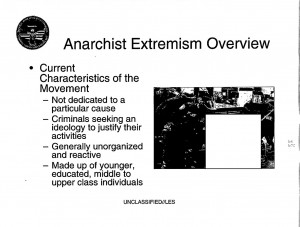
Their meeting locations include “college campuses, underground clubs, coffee houses/ internet cafes.” Their criminal activity includes “Sleeping Dragons” (a form of civil disobedience in which people lock arms in PVC pipes).
Anarchists are also “paranoid / security conscious,” according to the presentation. This is an interesting observation coming from the FBI, considering there have been two recent cases where the FBI played a key role in infiltrating anarchist groups in order to orchestrate alleged terrorist attacks. In the Cleveland May Day arrests, and in theChicago NATO arrests, the FBI trumpeted the arrest of “terrorists” that agents themselves tried desperately to create.
However, not all anarchists are engaged in these types of plots, the FBI acknowledges. They use a “variety of tactics” including “civil disobedience” (such as resisting home foreclosures, creating community gardens, and many other activities not mentioned by the bureau).
The FBI also warns that anarchists may have “crossover ideologies” including animal rights extremism and environmental extremism.

Animal rights / environmental extremism

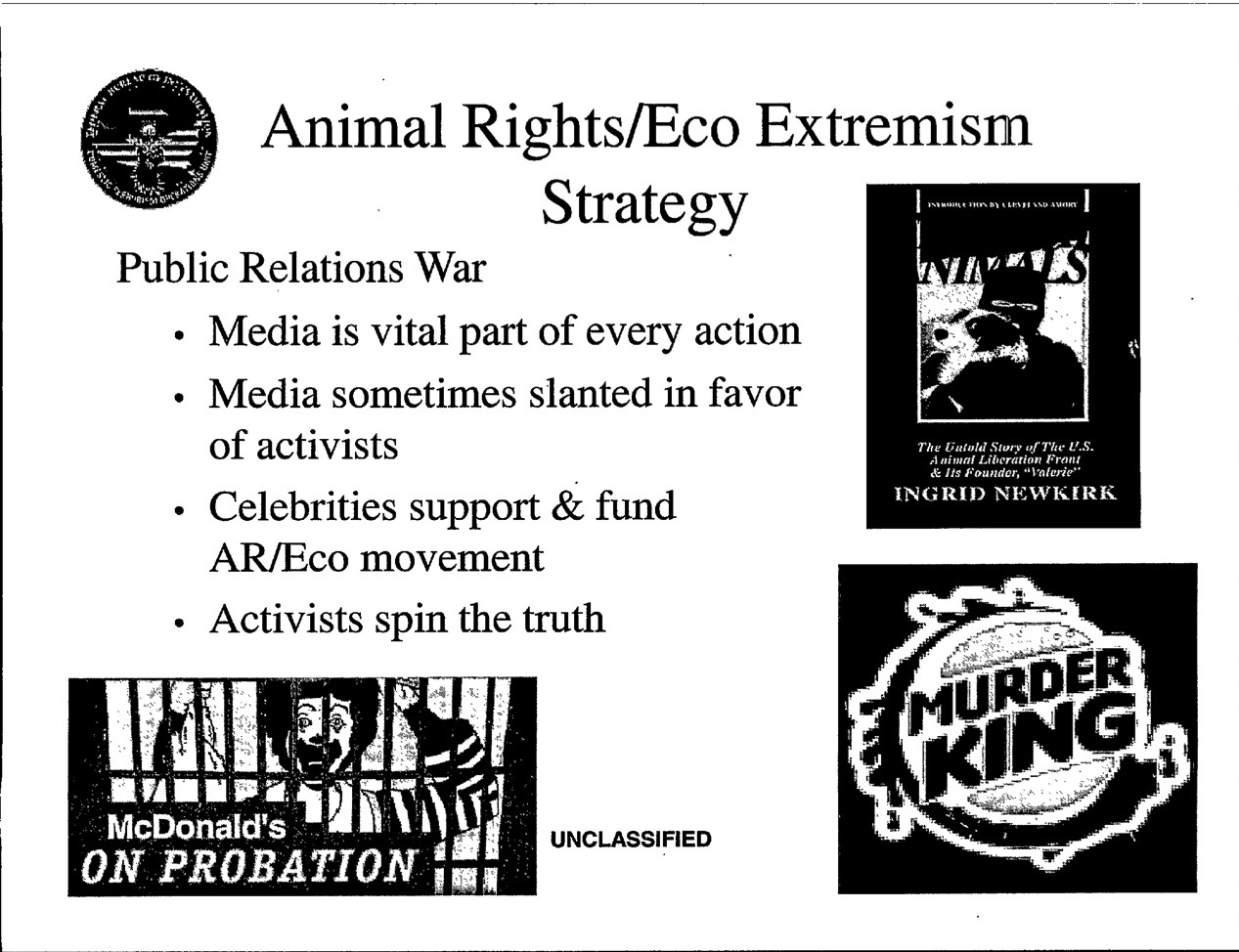
In the training presentation on these so-called “eco-terrorists,” the FBI lists lawful, First Amendment activity and low-level criminal activity (such as civil disobedience) as examples of domestic terrorism.
The FBI is particularly focused in these presentations on information gathering and what it calls a “public relations war” by activist groups. “Media is sometimes slanted in favor of activists,” the FBI says. “Activists spin the truth.”
Examples of information gathering listed by the FBI include requests for public documents under the Freedom of Information Act. In one presentation, FOIA requests are listed as examples of “University targeting.”
Elsewhere the FBI warns of “cold calls” and using “USDA Report [sic].”
The FBI also warns of activist attempts to use “false employment.” This is undoubtedly related to activists who seek employment at factory farms and vivisection labs in order to expose animal welfare abuses. As I have reported here previously, the FBI has considered terrorism charges for non-violent undercover investigators. And multiple states have been seeking to criminalize undercover investigations as well.
As I document in Green Is the New Red, there has been a slow and relentless expansion of “terrorism” rhetoric and investigations over the last 30 years. This type of language and FBI investigation was initially confined to property crimes by the Animal Liberation Front and Earth Liberation Front (groups that have caused millions of dollars in economic loss, but have never harmed a human being).
Now this already-broad terrorism classification has been expanded even further.  The Animal Enterprise Terrorism Act was drafted to target anyone who causes the “loss of profits” of an animal enterprise. The FBI acknowledges this shift in “terrorism” investigations in a slide that says the new law “alleviates the use of force or violence criteria.”

Relentless Expansion of “Domestic Terrorism”

The ACLU’s Mike German has an excellent dissection of the FBI’s “black separatist” documents. German writes:
Who are “Black Separatists” and is there any evidence they pose a terrorist threat?
Internet searches of “Black Separatist terrorism,” “Black Separatist bombing,” and “Black Separatist shooting” fail to bring up any recent incidents that could be fairly described as terrorist violence. No “Black Separatist” terrorist incidents are included in the FBI’s list of “Major Terrorism Cases: Past and Present,” nor on the more comprehensive list of terrorist attacks going back to 1980, which are detailed in an FBI report entitled “Terrorism 2002-2005.” While Black nationalist groups like the Black Panthers and the Black Liberation Army were certainly involved in political violence back in the 1970s, they no longer exist, and the last acts of violence attributed toeither group were more than two decades ago.
So why are Atlanta FBI agents now searching for black separatist threats?   Because the FBI appears to be training them to believe there is one using factually flawed materials.
The FBI is targeting “black separatists,” anarchists, animal rights activists, and environmentalists in nearly identical methodologies. And these new documents show just how little these tactics change over time and between movements.
The FBI is manufacturing these “terrorism threats” through what I would call a process of conflation. Disparate groups are being conflated, across ideological and tactical divides, and presented as a united “threat.” For instance, the FBI notes that “black separatists” are a movement that “consists of multiple groups” lacking a unified ideology, but they are lumped together because they “all share racial grievances against the U.S., most seek restitution, or governance base [sic] on religious identity or social principals [sic].”
Just as the FBI invented a new class of domestic terrorists in 2009 called “American Islamic Extremists,” the FBI long ago embraced a new class of domestic terrorists called “eco-terrorists.” A wide range of groups, from the Humane Society to the Animal Liberation Front, have been conflated into this catch-all term. This use of language is essential to the demonization of entire social movements because it aides in reshaping them as an “other.” They are not individuals with specific political grievances, they become a mass of unreasonable extremist threats.
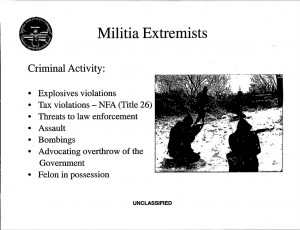
At the same time, the FBI is conflating a wide range of tactics. People who support anarchists or “black separatists” in their words are conflated with the very small group of people who have engaged in illegal activity. That’s how the FBI is including FOIA requests and civil disobedience as example tactics in a domestic terrorism presentation. Juxtapose this with the tactics of militia extremists and white supremacists, who have murdered, lynched, bombed, assaulted government officials and created weapons of mass destruction.
To most reasonable people, such a stark disparity between these groups would raise questions about how the FBI is allocating its domestic terrorism resources. How did such misguided policies come about?
These presentations point to one possible answer to that question: The FBI creates terrorism threats by directly training agents to believe they exist.

Monday, April 16, 2012

OWS is back, baby!

Reading up on some basic political philosophy has reminded me that the fundamental question of that discipline is, How should we choose to organize society? It's an obvious point, but easy to miss in the everyday specificity of political issues like Supreme Court rulings or party competition.

Which makes me think of the Occupy movement. This week the New York section of the movement returned to the streets: now they're literally on Wall Street. This is the first successful occupation from OWS since they were evicted from Zuccoti Park in November, following a three-month encampment.

Here's why the question of how to organize society makes me think of Occupy. Between September and November of last year, it seemed like everyone was criticizing the movement for lacking clear goals. Here's a particularly cantankerous bit of advice from someone's Dad:

I am unsympathetic. Blocking streets to prevent commuters from picking up their children and getting home to their families, shutting down banks so folks can't cash their paychecks and disabling ATM machines with super glue isn't sticking it to "the man." It simply does injury to the true 99 percent, the hardworking people trying to make a living, obeying the laws and paying taxes. 


While I still think it's just not true that the movement lacks goals--anti-plutocrat seems like a pretty specific agenda to me--there's an element of truth in these criticisms. OWS lacks conventional goals in the sense that it's about more than specific changes in policy. Simply, say, reversing the Citizen's United ruling, or prosecuting top players from the 2008 financial collapse, or even electing Ron Paul (or whoever) wouldn't fulfil Occupy's goals.

OWS is, even more than an expression of outrage at banksters and croney capitalism, an experiment in a different way of doing politics. A different way of being political. As Bernard Harcourt argues here, here, and here, stuff like consensus voting, call-and-repeat forums, and the absence of leaders are examples of how OWS functions according to a different format from conventional US politics. A different way of speaking and thinking about politics. A different (pardon the buzzword) discourse of how we can best organize our society. And it seems to me that this, this radical attempt to reinvent the way that we talk/think/do politics is more valuable than any conventional demand that the movement might make.

Wednesday, March 28, 2012

Gay Rights, AIDS, and Public Health

 If you're a queer man then you know that the rise of the AIDS epidemic was the moment when we galvanized. If the Stonewall riot of 1969 was our Pearl Harbor, then AIDS was our 9/11. Gay man after gay man died, suddenly but slowly enough to suffer, their bodies literally falling apart one process at a time. If you don't know this and you're a man and you have sex with men, then go here immediately.

And we—or rather, our predecessors—reacted. Groups like ACT-UP and Gay Men's Health Crisis took to the streets and phones to agitate. Recall that this was during Reagan's White House—years of “gay plague” passed before the president said the word “AIDS” in public. The bloc of queer activism which endures to this day—which we have to thank for the recent end of Don't Ask, Don't Tell and the imminence of national gay marriage—was born of the fact that gay men had a choice: fight, or die. Take your rights, or die. Become recognized, respected, political--or die. 

Not that 2012, three decades after the initiation of AIDS, has seen the erasure of homophobia. The HIV epidemic persists—indeed, it may be on the rise among young gay men because of the effects of new medications on risk-perceptions. Three decades of survivors are still with us, still surviving. Plenty of Americans give money to have us imprisoned or killed en masse,  or—perhaps worse—forced back into the closet. Queer kids still get bullied to death. Queer adults (some groups more than others) still get beaten and raped and killed for who they are or what they're perceived to be. Presidential candidates make opposing our very existence talking points during stump speeches.

BUT! But. But things are better, by any reasonable estimation. Marriage and the military are just two concrete examples of a broader progress we've made. Explicit homophobia is more or less rude in mainstream society, like farting or smoking. Our position as a threatened sub-group has improved tremendously during my lifetime.

What hasn't improved is: poverty. In fact, as the Occupy Wallstreet movement emphasizes, the gap between rich and poor has continued to expand in the past thirty years, following a trend which has held for twice a long. The gap between the medical care the two groups receive has stretched correspondingly: rich heiresses receive plastic surgery on their reality TV shows while ERs around the country function as de facto clinics to hoards of the tired and hungry, charging loan-shark rates for their services. If the position of queer men has improved, that's because we're moving up the ladder of inequality. The country hasn't improved, so much as it's improvedfor us.

What I want to highlight is how this issue of poor-healthcare intersects the issue of gay men's ascent from criminalization to contempt to grudging acceptance. This intersection occurs in two ways. First, there's the practical fact that in a country with fair healthcare, AIDS wouldn't have been nearly as devastating for gay men or anyone else. If our healthcare were modelled aroundreasonable-need and long-term public welfare,  instead of stop-gap emergency care and profit, we wouldn't have needed to wait for years—until a white, hemophiliac child named Ryan White died from AIDS after receiving an infected blood transfusion—for our government and our country to do something about the epidemic. And if we'd had fair healthcare, it's a good bet that HIV wouldn't have been as widespread. In short: if America had had fair healthcare for everyone, then homophobic apathy wouldn't have literally killed thousands of gay men throughout the 80s.

So it’s awesome that we galvanized into a national movement to demand fair treatment and equal rights, in the face of this horrific epidemic and sickening complacency. Awesome, but insufficient. Even though our position has improved, the medical system which casually allowed thousands (by now, millions) to die, the medical system which openly values lives according to dollars and social status, is still in place. Question: if next year some new plague swept through, say, migrant worker populations, or the homeless, or the incarcerated, does it seem plausible that the rest of us might just let them die, until our friends and neighbours began to get infected? Homophobia has decreased since 1981, but America’s willingness to let the poor die is as strong as ever.

This is the second intersection between poverty-healthcare and gay men as a political entity. When we appeal to straight America for fair treatment, our argument is based in a larger view of justice, equality, and human decency. We don’t want to be treated as gays; we want to be treated as human beings. There is, properly speaking, no such thing as gay rights. There are only human rights, and the groups to whom human rights are denied. As a consequence, our movement, our political bloc, can only demand equal protections and dignity for queer people when we demand them for all people. Our movement is only legitimate insofar as it advocates for all people’s dignity.

That is why it is simply not good enough for us to move up the ladder of inequality. We must be committed to equality in general, for all, queer and otherwise, and especially for the poor. And that means fair healthcare.

Thursday, February 23, 2012

Occupy Activists From Across US And Abroad Converge in Olympia

Over President's Day weekend, Olympia, Washington became the first city in the nation to host a major national occupy movement conference. Activists from all across the country gathered to participate in three days of organizing activities, including dozens of workshops, training sessions and meetings. The Occupy Solidarity Social Forum was sponsored by the Alliance For Global Justice and Occupy Olympia.

Over 300 people attended the event, and organizers are calling it a great success. Due to the large number of activists on board an Amtrak train coming in from California, folks along the route renamed it the "Occupy Express." The train was met by a boisterous welcoming party of conference organizers when it arrived at the station in East Olympia.

READ MORE>>>

Saturday, November 19, 2011

Police officer pepper-sprays seated, non-violent students at UC Davis


By  at 8:35 pm Friday, Nov 18

At the University of California at Davis this afternoon, police tore down down the tents of students inspired by the Occupy Wall Street movement, and arrested those who stood in their way. Others peacefully demanded that police release the arrested.
In the video above, you see a police officer [Update: UC Davis Police Lt. John Pike] walk down a line of those young people seated quietly on the ground in an act of nonviolent civil disobedience, and spray them all with pepper spray at very close range. He is clearing a path for fellow officers to walk through and arrest more students, but it's as if he's dousing a row of bugs with insecticide.
Wayne Tilcock of the Davis-Enterprise newspaper has a gallery of photographs from the incident, including the image thumbnailed above (larger size at davisenterprise.com). Ten people in this scene were arrested, nine of whom were current UC Davis students. At least one woman is reported to have been taken away in an ambulance with chemical burns.
This 8-minute video was uploaded just a few hours ago, and has already become something of an iconic, viral emblem accross the web. We're flooded with eyewitness footage from OWS protests right now, but this one certainly feels like an important one, in part because of what the crowd does after the kids are pepper-sprayed. Watch the whole thing.
There's a related post on the Occupy Cal blog.
Thanks to the numerous Boing Boing readers who @'ed or emailed this one in. It's hard to come up with an alternate narrative that explains away the impression one gets from watching this, which is "pure awful brutality."
[Photo: Wayne Tilcock/, Davis-Enterprise ]

Monday, October 03, 2011

Taking Ourselves Seriously: Developing Strategy for Social Transformation


A talk led by longtime anarchist organizer and author Chris Dixon!

A short talk will be followed by discussion. Come one, come all!

Sponsored by the Institute for Anarchist Studies - http://www.anarchist-studies.org/

The question of strategy - how we might win in the near and long term as we struggle against domination, exploitation, and oppression - is pressing. As anti-authoritarians, however, we frequently face barriers to thinking and acting strategically. These include fixating on principles over plans, fetishizing specific tactics, and organizing in crisis modes. Drawing on interviews with organizers across North America, this presentation will discuss these barriers, and potential ways we can move past them toward developing effective approaches for the long haul of social transformation. Together, we will explore how to build movements in the world as it is - engaging with where and how people are struggling - while cultivating strategies toward the world that we want. Emphasizing history and research, this presentation will especially highlight strategic approaches based on fighting for non-reformist reforms and building dual power.

Bio:
Chris Dixon, originally from Alaska, is a longtime anarchist organizer,
writer, and educator who recently received his PhD from the University of California at Santa Cruz. He lives in Sudbury, Ontario, where he is involved with anti-war and Indigenous solidarity organizing. Dixon serves on the board of the Institute for Anarchist Studies and the advisory board for the journal Upping the Anti. He is currently completing a book, tentatively titled Against and Beyond, based on interviews with anti-authoritarian organizers across the U.S. and Canada involved in broader-based movements.