Showing posts with label Deep Green Resistance. Show all posts

Saturday, June 02, 2012

Newly Released FBI “Domestic Terrorism” Training on Anarchists, Environmentalists, Show COINTELPRO Tactics

Lifted in whole from www.greenisthenewred.com, an excellent blog we have been and will continue to be reposting choice pieces from regularly since our initial discovery a few months ago. Keep 'em comin'! Oy, and let's see some feedback on our blog right here too folks! We want to hear from you so we can better mold our posts to our readership's interests. Should we do a survey or something?
-editor @ Last Word Books & Press, Oly, Wa.


http://www.greenisthenewred.com/blog/fbi-domestic-terrorism-training-anarchists-eco/6199/

by WILL POTTER on MAY 29, 2012

Newly released FBI presentations show the flawed and misleading information the government is using to train agents to identify and investigate “domestic terrorist” groups such as “black separatists,” anarchists, animal rights activists, and environmentalists.
Among the more troubling portions of the training materials are warnings of activists using the Freedom of Information Act, engaging in non-violent civil disobedience, and gathering in coffee shops.
The domestic terrorism training materials were obtained through the Freedom of Information Act by the ACLU. They offer additional insight into a disturbing pattern of FBI activity misrepresenting political activists as “terrorists” and manufacturing “domestic terrorism threats” where none exist, akin to the notorious COINTELPRO program of J. Edgar Hoover.

Anarchists Are “Criminals Seeking an Ideology”

– Anarchists are “Criminals seeking an ideology to justify their activities”
– Anarchists are “Not dedicated to a particular cause”
– Green anarchists believe “individuals should ‘get back to nature’”
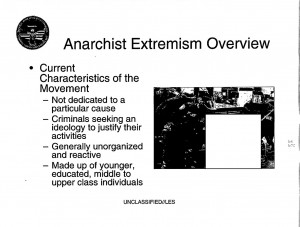
Their meeting locations include “college campuses, underground clubs, coffee houses/ internet cafes.” Their criminal activity includes “Sleeping Dragons” (a form of civil disobedience in which people lock arms in PVC pipes).
Anarchists are also “paranoid / security conscious,” according to the presentation. This is an interesting observation coming from the FBI, considering there have been two recent cases where the FBI played a key role in infiltrating anarchist groups in order to orchestrate alleged terrorist attacks. In the Cleveland May Day arrests, and in theChicago NATO arrests, the FBI trumpeted the arrest of “terrorists” that agents themselves tried desperately to create.
However, not all anarchists are engaged in these types of plots, the FBI acknowledges. They use a “variety of tactics” including “civil disobedience” (such as resisting home foreclosures, creating community gardens, and many other activities not mentioned by the bureau).
The FBI also warns that anarchists may have “crossover ideologies” including animal rights extremism and environmental extremism.

Animal rights / environmental extremism

In the training presentation on these so-called “eco-terrorists,” the FBI lists lawful, First Amendment activity and low-level criminal activity (such as civil disobedience) as examples of domestic terrorism.
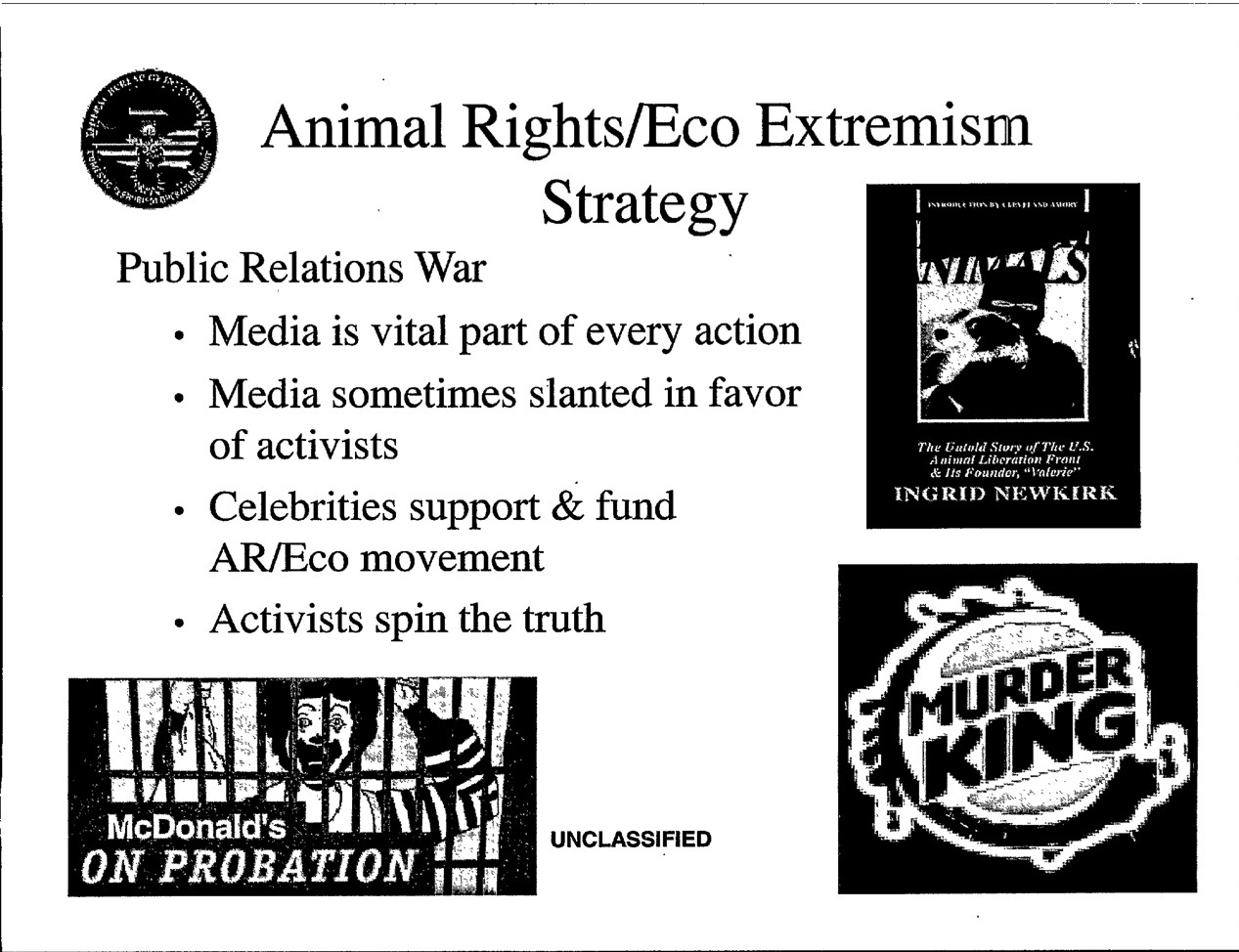
The FBI is particularly focused in these presentations on information gathering and what it calls a “public relations war” by activist groups. “Media is sometimes slanted in favor of activists,” the FBI says. “Activists spin the truth.”
Examples of information gathering listed by the FBI include requests for public documents under the Freedom of Information Act. In one presentation, FOIA requests are listed as examples of “University targeting.”
Elsewhere the FBI warns of “cold calls” and using “USDA Report [sic].”
The FBI also warns of activist attempts to use “false employment.” This is undoubtedly related to activists who seek employment at factory farms and vivisection labs in order to expose animal welfare abuses. As I have reported here previously, the FBI has considered terrorism charges for non-violent undercover investigators. And multiple states have been seeking to criminalize undercover investigations as well.
As I document in Green Is the New Red, there has been a slow and relentless expansion of “terrorism” rhetoric and investigations over the last 30 years. This type of language and FBI investigation was initially confined to property crimes by the Animal Liberation Front and Earth Liberation Front (groups that have caused millions of dollars in economic loss, but have never harmed a human being).
Now this already-broad terrorism classification has been expanded even further.  The Animal Enterprise Terrorism Act was drafted to target anyone who causes the “loss of profits” of an animal enterprise. The FBI acknowledges this shift in “terrorism” investigations in a slide that says the new law “alleviates the use of force or violence criteria.”

Relentless Expansion of “Domestic Terrorism”

The ACLU’s Mike German has an excellent dissection of the FBI’s “black separatist” documents. German writes:
Who are “Black Separatists” and is there any evidence they pose a terrorist threat?
Internet searches of “Black Separatist terrorism,” “Black Separatist bombing,” and “Black Separatist shooting” fail to bring up any recent incidents that could be fairly described as terrorist violence. No “Black Separatist” terrorist incidents are included in the FBI’s list of “Major Terrorism Cases: Past and Present,” nor on the more comprehensive list of terrorist attacks going back to 1980, which are detailed in an FBI report entitled “Terrorism 2002-2005.” While Black nationalist groups like the Black Panthers and the Black Liberation Army were certainly involved in political violence back in the 1970s, they no longer exist, and the last acts of violence attributed toeither group were more than two decades ago.
So why are Atlanta FBI agents now searching for black separatist threats?   Because the FBI appears to be training them to believe there is one using factually flawed materials.
The FBI is targeting “black separatists,” anarchists, animal rights activists, and environmentalists in nearly identical methodologies. And these new documents show just how little these tactics change over time and between movements.
The FBI is manufacturing these “terrorism threats” through what I would call a process of conflation. Disparate groups are being conflated, across ideological and tactical divides, and presented as a united “threat.” For instance, the FBI notes that “black separatists” are a movement that “consists of multiple groups” lacking a unified ideology, but they are lumped together because they “all share racial grievances against the U.S., most seek restitution, or governance base [sic] on religious identity or social principals [sic].”
Just as the FBI invented a new class of domestic terrorists in 2009 called “American Islamic Extremists,” the FBI long ago embraced a new class of domestic terrorists called “eco-terrorists.” A wide range of groups, from the Humane Society to the Animal Liberation Front, have been conflated into this catch-all term. This use of language is essential to the demonization of entire social movements because it aides in reshaping them as an “other.” They are not individuals with specific political grievances, they become a mass of unreasonable extremist threats.
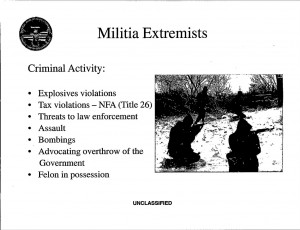
At the same time, the FBI is conflating a wide range of tactics. People who support anarchists or “black separatists” in their words are conflated with the very small group of people who have engaged in illegal activity. That’s how the FBI is including FOIA requests and civil disobedience as example tactics in a domestic terrorism presentation. Juxtapose this with the tactics of militia extremists and white supremacists, who have murdered, lynched, bombed, assaulted government officials and created weapons of mass destruction.
To most reasonable people, such a stark disparity between these groups would raise questions about how the FBI is allocating its domestic terrorism resources. How did such misguided policies come about?
These presentations point to one possible answer to that question: The FBI creates terrorism threats by directly training agents to believe they exist.

Saturday, March 17, 2012

An Ode to the Movement: Jensen brings it back home

In stock at Last Word Books!

Review of Truths Among Us: Conversations on Building a New Culture, a collection of interviews by Derrick Jensen, PM Press, 2012

By Sasha
Derrick Jensen can be a very enigmatic author. At one point he is talking about preserving nature by destroying civilization, and then in a blink of an eye he is engaging you on the subject of violence against women or civil war in Guatemala. This is because, for Jensen, the datum of abuse is civilization. We will finally be able to heal from our trauma and abusive behavior when we dismantle the idea of civilization and live in peace with one another. In his books, Jensen is constantly referring to his friends—his socialist friend, his feminist friend, his indigenous activist friend—who are reminding him to remain humble and informing his thoughts all the time. But who are these friends, and how can we figure out where their independent thoughts intersect with Jensen’s?
That is where Truths Among Us comes into play. Interviewing a diverse array of activists, scientists, and theorists, Jensen strikes to what is personal in all of our experiences with abuse, and finds the healing kernel of love in an intimate relationship with one another, mediated by nature. Civilization, here, is the abusive intervention in natural relationships; it is—via capital, commercialism, colonialism, etc—what pits us against one another through shame, competition, or outright victimization.
In today’s heated terrain of ideological polarization and alienation, Truths Among Us comes as a breath of fresh air. What strikes the reader at first are the names on the front cover. Jensen interviews sociologist Stanley Aaronowitz, feminist Jane Caputi, activist Luis Rodriguez, and a careful selection of other important thinkers. Throughout the book, Jensen’s own voice is subsumed within a broader discourse about science, activism, biodiversity, and social issues. Aaronowitz’s marxian socialism illuminates a surprising link with Jensen’s autonomous, primitivist views on the basis of a critique of technological civilization and contemporary science. Here, the alienated stance of scientism is challenged by appealing to the traditions of the philosophy of science, Isaac Newton, Albert Einstein, and a host of other thinkers whose thoughts have been sacrificed at the alter of “method”.
In place of science as it exists in today’s highly professionalized and corporatized world, Jensen seeks out Marc Ian Barasch, the former editor of The New Age Journal, for some actionable medical knowledge. Barasch pulls on ideas of the collective unconscious hashed out across the world, from Carl Jung to Hasidic tradition to Buddhism. Presenting an interesting case for curing cancer through a personal quest of self-healing, Barasch explains that by listening to his dreams and following his desires he was able to win his battle with the scourge of modern civilization.
Accompanying self-healing, Jensen makes special inquiries into bioremediation with renowned mycologist Paul Stamets. Through the activities of fungi and mycelial mats, ecosystems are able to regenerate to a mind boggling extent, Stamets declares. Pursuing this knowledge base might be the key to restoring devastated ecosystems and returning to wild nature. Another interview with activist John Keeble exposes that the connection between bioremediation of Super Fund sites and other biohazard locations might have a lot to do with a sociological turn away from white supremacy and corporate control. Corporations “rob the world of its subjectivity,” says Keeble, “They are culturally sanctified, supported, and protected in their role of turning the living—forests, oceans, mountains, rivers, human lives—into the dead: money” while hate groups “serve that same function of objectifying. Their entire self-definition is based on this objectification.”
To get a closer understanding of the problems of hate and objectification, Jensen turns to influential professor and critic of patriarchy, Jane Caputi. In this interview, Jensen’s personality shines through; he draws on his own experience and strikes to the core of our collective trauma as well as the need for recovery. What Caputi shows us is that oppression is afflicted within before it is afflicted without; in rape for instance, what the perpetrator is “afraid of—perhaps even more profoundly than getting a dose of their own violence—is the feminine within themselves, the chaos represented by the wilderness.” Hence, the connection between the assault against nature and the assault against particular groups grows more keen, and is elucidated further by Jensen’s discussion with Luis Rodriguez.
A best-selling author whose autobiographical work, Always Running: La Vida Loca, Gang Life in L.A., describes life as a gang member in South Central LA. Rodriguez discusses the need for place amongst inner city youth whom economic structures have abandoned. “[Gangs] are products of the industrial age,” declares Rodriguez, who also touches on the subject of the collective unconscious. “[W]e all have an ancestral pool of knowledge and experience that we’ve somehow forgotten about… in their bones these kids are indigenous people.” Raised on a reservation in New Mexico and trained as a Tzutujil Mayan shaman in Guatemala, Martín Prechtel also provides Jensen with an important connection to the indigenous: “We are all still human beings. Some of us have buried our humanity deep inside, or medicated or anesthetized it, but every person alive today, tribal or modern, primal or domesticated, has a soul that is original, natural, and, about all, indigenous in one way or another.” In contrast to the notion of indigeneity, love, and appreciation, professor Richard Drinnon provides a sweeping analysis of the connections between modernity, industrialism, and racism, asking the question, “Where can an attempted dominion over nature and self lead but to the eradication of feelings in any kind of fully human way?” The answer comes through Jensen’s interview with trauma expert Judith Herman: “If you’re part of a predatory and militaristic culture, then to behave in a predatory and exploitative way is not deviant, per se.”
To fit this many observations in a single work while pulling so many voices into a bricolage of diverse and complimentary discourse is a momentous achievement by Jensen, and it is sorely needed today. Which brings me to the next interesting aspect of Truths Among Us: many of the interviews took place before 9/11 and the Green Scare, bringing together a number of voices in an interesting time capsule; a point when “the movement” had the ability to articulate particular demands with far more discursive freedom. One can see in the history of Jensen’s writings a complicated tension between the right-wing anarchist-primitivist tradition and left wing socialist thought. Jensen’s own writing, which culminated in the monumental, prophetic lamentations of, Endgame, has always played along a tight-wire of resistance, moving between prison advocacy to animal welfare sympathies to feminism and post-colonial theory, while maintaining what one might call an autonomous political position. While the anarchist right has chided him for endorsing a liberal mindset, much of the liberal left has disassociated itself from Jensen’s antipathy for reforms.
When Jensen released Deep Green Resistance with controversial anti-vegan primitivist Lierre Keith and anarchist Aric McBay, he was criticized heavily from the left, which blamed DGR for adding fuel to a cultish right-wing tendency within primitivism that has attacked at various times vegetarianism, antiracism, feminism, and queer activism. This “backlash” against the left, however, is far from Jensen’s line of thought. The release of these interviews dating back to the late nineties is a relief from the infighting and disruption that has plagued activists in recent years, and an invitation to escape the repressive dead ends of reactionary discourse.
The glance back at the wonderful things that activists have done and said in solidarity with a global movement against oppression and pathological abuse serves as an inspirational (if not nostalgic) reminder of the relationships of solidarity that Jensen has helped to protect over the past two decades, and a motivation to embrace different people, different ideas, and different walks of life. It is a rewarding book, well worth the read, and is, ironically, perhaps a better reference point for Jensen’s thought than any other of his works that I have read.

Wednesday, February 15, 2012

Press Release: Anonymous Hacked Documents Reveal Law Enforcement Spied on Occupy and Shared Information with Private Intelligence Company, STRATFOR

Thanks for the tip Technoccult!

FOR IMMEDIATE RELEASE
January 26, 2012
Contact Deep Green Resistance:
Lierre Keith lierrekeith[at]yahoo[dot]com Aric McBay aric[at]aricmcbay[dot]org
(847) 773-7478
View documents here.

View Deep Green Resistance response and picture of Stratfor employee here.

Computer hackers known as Anonymous leaked information obtained by hacking into private intelligence firm Stratfor’s computer network. The documents – what Anonymous is calling a teaser – suggest that from at least October to November 2011 Stratfor worked with Texas law enforcement to infiltrate the Occupy movement and spy on the Deep Green Resistance movement. The document contains emails in which Stratfor employees discuss Occupy Austin and Deep Green Resistance. Stratfor “Watch Officer” Marc Lanthemann writes about receiving information on Occupy Austin and DGR from a “Texas DPS agent.” The Texas Department of Public Safety is a statewide law enforcement agency that includes an Intelligence and Counterterrorism Division.

Deep Green Resistance condemns the surveillance and infiltration of activist groups by law enforcement and private corporations and calls on activists and their allies to expose and protest this violation of all of our constitutional rights.

“Law enforcement sharing information about local activism with private intelligence firms should be a huge scandal,” writes Rachel Meeropol, staff attorney at the Center for Constitutional Rights. “Privately funded surveillance and infiltration of activist groups is especially chilling, as time and again we see such corporations operate as if they are above the law and accountable to no one.”

In the emails, the staff discuss how a Texas DPS agent went undercover and tried to gather information from an Occupy Austin General assembly, as well as receiving information from what he calls “my Occupy people” about people they assumed were in Deep Green Resistance. Comments in the email suggest that the agent’s surveillance of Occupy Austin was ongoing and continued past the incidents described. In addition, the Stratfor staff describe doing online research on DGR Austin and Deep Green Resistance more generally. They wrongly described the purpose of a DGR Austin public meeting on what radicalism means for Austin as “indoctrination”; they wrote about the book Deep Green Resistance, and they speculated about the relationship between DGR Austin and other groups.

Stratfor and law enforcement not only violated activists’ constitutional rights, they also were grossly incompetent. Their report is full of hasty generalizations and inaccuracies. They confuse members of the DGR action group in Austin (which does exist) with another group they call the “Phoenix commune” (which may or may not exist). And they allege a conflict between members of the DGR Austin group and Occupy Austin that doesn’t seem to have happened. It’s not clear if this is part of the strategy counterintelligence groups have used in the past to try to provoke conflict between different social movements—the FBI used this very effectively against groups like the Black Panther Party—or whether Stratfor is simply relying on unreliable or incompetent sources.

In addition, their claim that DGR is inspired by Nazism and philosopher Martin Heidegger is outrageous and obviously wrong. As is their claim that DGR “is focused on creating a situation where violent confrontation will be the ultimate outcome.” It doesn’t require an agent to get simple facts correct. Both of these assertions are just plain false.

In December 2011, Anonymous attacked the Stratfor website, allegedly stealing 200 gigabytes of data and shutting the site down for weeks. Anonymous has gone after such corporations before, such as internet security firm HBGary. They released private documents that included secret plans by HBGary and others to attack and discredit Wikileaks on behalf of big banks.

There is a long history of clandestine groups releasing secret information about the surveillance of social movements. In 1971, and underground group called the Citizen’s Commission to Investigate the FBI broke into an FBI field office and released thousands of pages of secret information, revealing that the FBI had attacked 1960s social movements with methods ranging from surveillance and infiltration to targeted assassinations. Though we have no contact with Anonymous, their leak of information about government and corporate tactics of repression is part of an important tradition. More leaked information from Stratfor is presumably forthcoming.