

Showing posts with label Printing. Show all posts
Showing posts with label Printing. Show all posts
Friday, September 12, 2014


Sunday, March 10, 2013
Writer' Handbook
Frantically working away assembling the various pieces of the Writer's Handbook by David Water. It'll be done soon and available for sale.


Friday, February 01, 2013
Recent Poster Design and Printing
Here's a little taste of what we've been up to in the print shop when you all thought we'd crawled off to hide in a dark hole. It may still be Winter but you can almost taste Spring slipping into the sheets to warm you at night. Things are slowly churning (as they always do) here at Last Word and our lethargy will soon give way as we begin working on several projects, including another edition of Slightly West for the fine freaks at The Evergreen State College. Stop by and see us soon.
.JPG)
Monday, December 31, 2012
Daily Bleed for December 31st, the Final Day of 2012, A Radical Anarchist Daybook
Thanks, as always, to Recollection Books, for compiling and mailing out the Daily Bleed for all this time!
Our Daily Bleed...

| People always ask what am i going to be when i grow up & i always just think i'd like to grow up
— Nikki Giovanni,
"Poem for Rodney," from Spin a Soft Black Song |

| DECEMBER 31
JOHN WYCLIFFE
Leader of the dangerous Lollards, 13th-century English spiritual revolutionaries. |
ANNUAL WORLD PEACE MEDITATION.NEW YEAR'S EVE. In Germany prowling demons & spirits of darkness must be routed this night by mummery & lots of noise. People used to dress in straw clothing with deerskin masks of animals & run through the streets, clanging & dragging chains (Birt?).Mobile, Alabama: COWBELLION HERD ESCAPADE & REVEL honors Michael Krafft, who founded mystic society, "Cowbellion de Rakin" in 1830, first of all the mystic societies & crewes which stage the Mardi gras extravaganza in Mobile & New Orleans.Japan: NAMAHAGE. Men dressed as devils go door-to-door screaming,"Any good-for-nothings here about?" (Birt?)Aztec Malinalli Day. A day for persevering against all odds & for creating alliances that will survive the test of time.It is a good day for those who are suppressed, a bad day for their suppressors.

-46 --  The last day of the Year of Confusion, a 445-day Roman year (OS).
The last day of the Year of Confusion, a 445-day Roman year (OS).
Ahhhhhh, the Good Ol' Days!
1320 -- John Wycliffe lives. Here...
1384 -- John Wycliffe dies. British radical clergyman, reformer, founder of "poor priest" movement, major influence on Lollards & later reformers. Dead & gone...
1646 -- Corneille's "Le Cid" becomes the first play performed in Quebec, Canada.
Corneille's "Le Cid" becomes the first play performed in Quebec, Canada.
1744 -- James Bradley announces discovery of Earth's nutation motion. The planet's a natural born "Wobbly."
1747 -- German poet, editor & translator Gottfried August Bürger lives. His ballads are among the finest in the German language. Bürger revived the sonnet form in German, & his experiments in it were praised as models by Schiller.
1775 -- Canada: American attack on the city of Quebec is launched during a blinding snowstorm. General Montgomery, one of the two American leaders, is killed, & the second, General Benedict Arnold, is wounded during the opening encounter. The attack fails, the Canadians having killed or wounded fully half the American troops.
1777 -- P.D.Q. Bach completes his "Gross Concerto," according to Schickele.
P.D.Q. Bach completes his "Gross Concerto," according to Schickele.
1817 -- James T. Fields lives, Portsmouth, New Hampshire. A partner in Ticknor & Fields, publishers, he will succeed James Russell Lowell as editor of the "Atlantic Monthly."
1830 -- Alexander Smith, Scottish poet/writer, lives, Kilmarnock.
1842 -- US: Yikes!? Alabama becomes first state to license dental surgeons. Creeping socialism!

1846 -- Holland: Ferdinand Domela Nieuwenhuis lives (1846-1919), Amsterdam.
Pioneer of Dutch anarchism & the International Anti-Militarist Association. Born in Amsterdam, a preacher in Harlingen in 1870. Leader of a socialist union & first socialist senator (1891) in The Netherlands. He then abandoned politics for the anarchism of Mikhail Bakunin in 1897.
1860 --
| Strange: December Fortean Events | Second fall of reddish rain (see Dec. 28, 1860), exact same quarter of Siena (see also Jan. 1, 1860) [Year Book of Facts, 1861-273] http://www.resologist.net/damn03.htm |
1863 -- Alfredo Panzini lives. Italian novelist, short story writer, essayist, who, in his lifetime, ranked with Carducci & D'Annunzio as a 'modern classicist', but is no longer held in such esteem. His style had similarities with the French writer Anatole France.

1869 -- Henri Matisse lives — Jazz, nice odalisques, goldfish, a wealth of choices...
1871 -- Ellen Horup, anti-militarist feminist, lives, Denmark.
1872 -- Can't Wait?: Though some of his work isn't recognized for almost another century, the creator of Finland's modern literature, Aleksis Kivi dies in Tuusula. His most widely read novel is Seitsemän veljestä (Seven Brothers).

1877 -- Gustave Courbet (1809-1877) dies. French painter, revolutionary socialist, man of independent character. Leader of the realist school.
Tuesday, March 27, 2012
Blueprint for the Occupy Movement? Read the Protest Manifestos of the 1960s
Very cool article from Collector's Weekly.


By Ben Marks
When I was invited into collector Rick Synchef’s home several months ago, I was drawn by the promise of signed rock posters from the San Francisco music scene, as well as first-edition copies of Beat poetry by such luminaries as Allen Ginsberg and Lawrence Ferlinghetti. But it was Synchef’s collection of flyers, pamphlets, and other ephemera, distributed by groups such as the Students for a Democratic Society (SDS) and the Yippies, that made the greatest impression on me.
“I was tear-gassed or pepper-sprayed about 30 times.”
At the time, Occupy Wall Street protestors had made the disparity of wealth in the United States a presidential campaign issue, while protestors in Oakland, California, shut down that city’s port, albeit briefly. As I looked at Synchef’s collection (only a tiny fraction of which is shown here), carefully removed from flat files stored beneath his bed and archival boxes packed into closets, it seemed as if the blueprints for the Occupy movement were being laid out before me.
Synchef began collecting political paper while still an undergraduate at the University of Wisconsin in Madison. “Madison was often referred to as the Berkeley of the Midwest,” Synchef recalls. “I thought I was politically aware, but Madison was an eye-opening experience.”
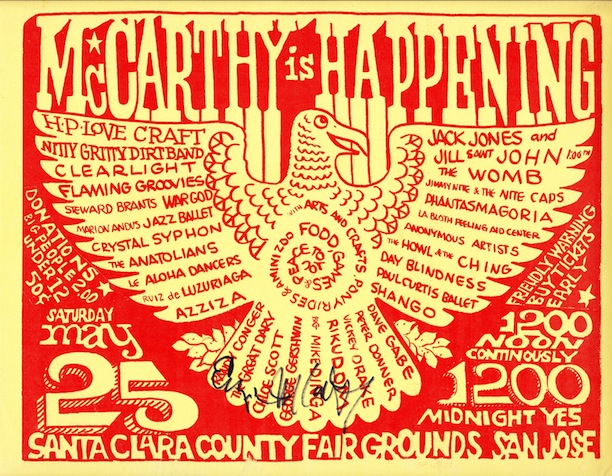
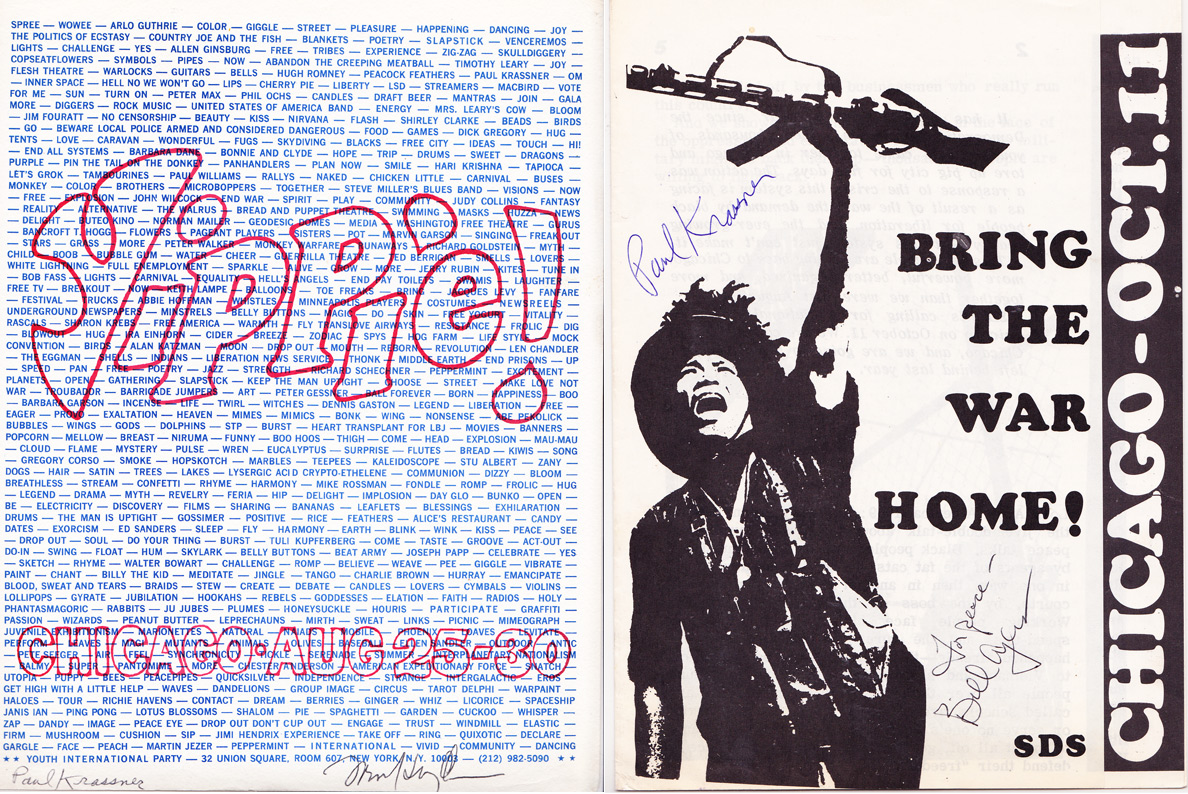
Top: A Eugene McCarthy for President event, 1968, signed by the candidate. Above, left: A Yippie flyer promoting events during the Democratic National Convention, 1968. Above right: The cover of an SDS booklet timed for the trial of Yippie and other leaders arrested at the August event.
Although the lightning-rod issue for student activists in the late ’60s was opposition to the war in Vietnam, Synchef remembers the motivation of the movement as being more far-reaching. “It was about human rights in general,” he says, “about trying to make people’s lives better and more meaningful.” It was also about challenging the power structure, particularly the incestuous relationship between government agencies and the corporations that benefited from their policies.
Sound familiar?
By 1970, demonstrations at Madison and many other universities were nearly constant, especially after May 4, when National Guard officers shot and killed four students at Kent State University in Ohio. “I estimate I was tear-gassed or pepper-sprayed about 30 times,” Synchef says of his four years at Madison. “Not me personally, but I’d be in situations where the cops would just fog the area with pepper spray. They’d drive by in vans and pepper-spray masses of people.”
These days, such events become instant Internet memes.
This 1969 flyer for an event in San Francisco advertised one of several peace marches around the country that day.
Against this backdrop, Synchef began collecting leaflets and other pieces of political ephemera. “I just started saving things, like handbills that had been stuck to telephone poles, or flyers used to promote events and speakers on campus. I knew we were going through a really significant and unique period in American history. I had a gut feeling that it might never happen again. This was before e-mails, before fax machines. Those pieces of paper were how people found out about events; they were never intended to be permanent. I thought, and I still think, that these things needed to be preserved. They’re a really important part of American history.”
Later, after graduating from law school at Northwestern University in Chicago, Synchef added to his collection by purchasing, “an occasional poster here and there,” as he puts it. “But what really spurred me on,” he says, “is that in the late 1980s, I happened upon a catalog of bohemia and ’60s literature—first editions and signed works. I call them cheap but meaningful pamphlets, but they were treated with respect in a catalog ordinarily reserved for rare books and manuscripts. Someone was making a real attempt to categorize and define these things in a logical and coherent way.”
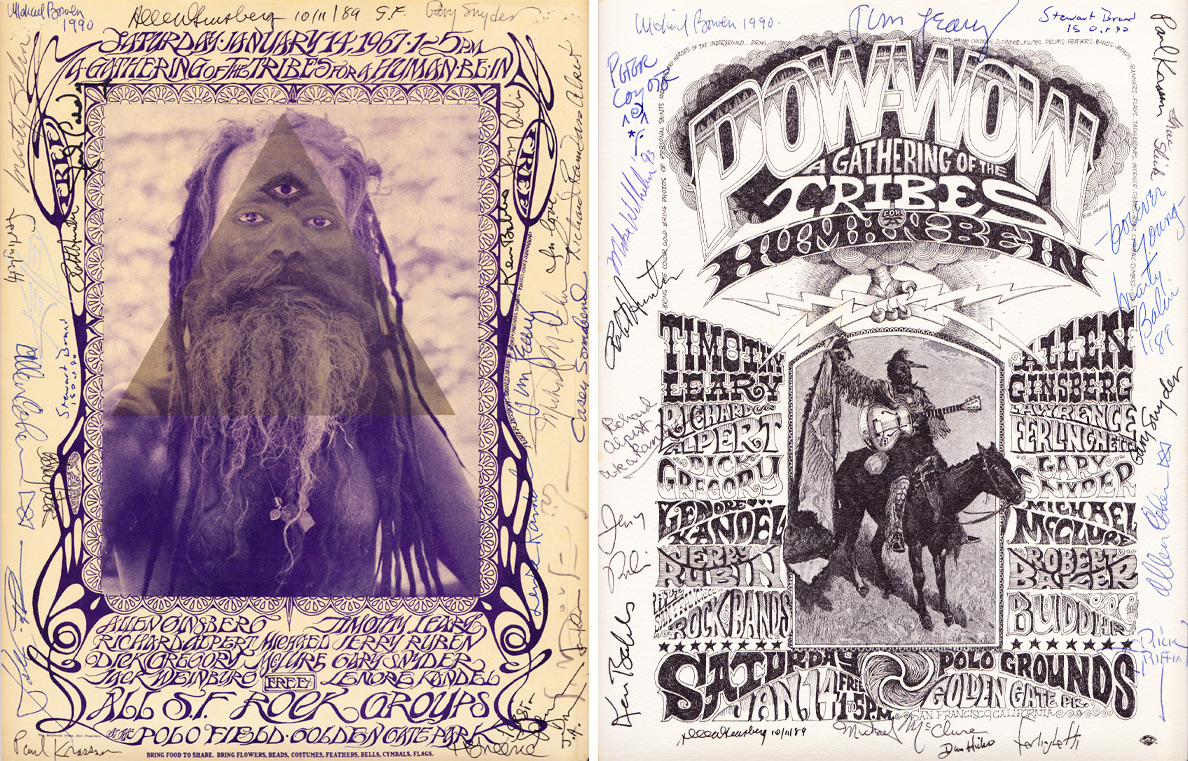
Two posters were produced for the Human Be-In in Golden Gate Park. The one on the left was designed by rock-poster artist Stanley Mouse and "Oracle" art director Michael Bowen. The one on the right is by rock-poster artist Rick Griffin. Synchef's copies have been signed by many of the day's participants, including Timothy Leary and Allen Ginsberg.
Synchef bought a few pieces from the catalog, “and then it became obsessive,” he says. “I actually ran a couple advertisements in paper-collector magazines, and learned how to preserve things in Mylar and archival cardboard boxes.”
Before long, he had collected ephemera produced by numerous branches of the counterculture, from underground newspapers such as “The East Village Other,” which served residents of that New York City neighborhood, to handbills promoting the famous Human Be-In, which was held on January 14, 1967, in San Francisco’s Golden Gate Park. Some events were tied to political causes, while others seemed more about the human spirit. “It’s all a continuum,” Synchef says. “The Student Nonviolent Coordinating Committee [SNCC] helped the summer freedom riders that went to the South in the early ’60s to register black voters. It’s really hard to draw boundaries between all the different types of, shall we say, human-potential movements.”
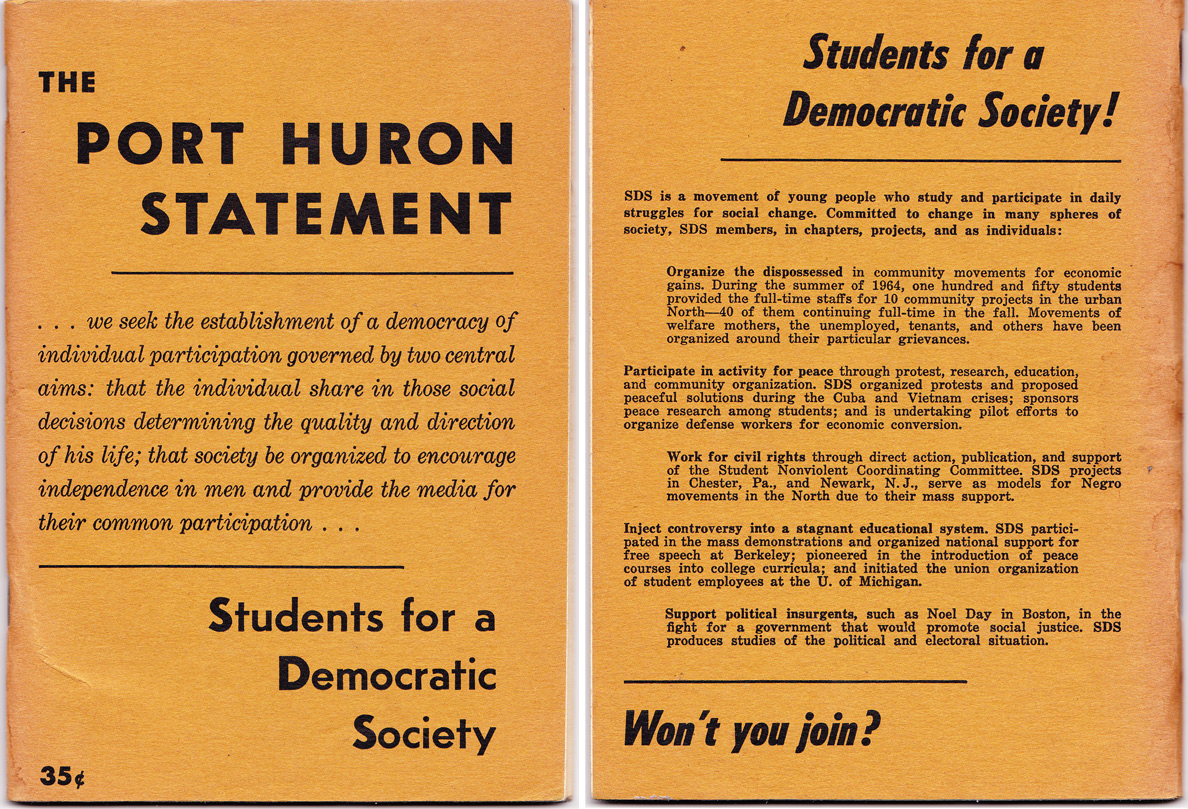
One of the earliest student-activism documents in Synchef’s collection is a copy of the Port Huron Statement. “In 1962, approximately 50 student leaders met from around the country in Port Huron, Michigan, to put together a declaration of principles, if you will, advocating for participatory democracy. Primarily written by Tom Hayden, the Port Huron Statement was a seminal document in student activism.”
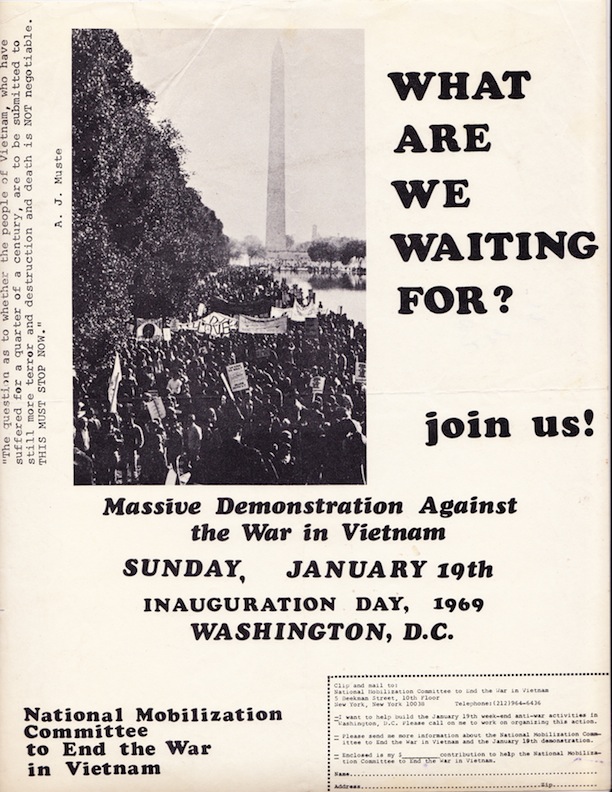
An anti-war protest march greeted President Richard Nixon on inauguration day.
Some of its tips, specifically the one to “make debate and controversy,” sound like tenets of Occupy Wall Street. “I went to a few Occupy events,” adds Synchef, “and I felt surprisingly like I did in the old days. People were really sincere. They were really trying to make a difference.”
Like many social observers, Synchef sees numerous parallels between the 1960s and today. “In the ’60s, the country was incredibly divided. You were either a hawk or a dove; there was no middle ground. Same is true today.” And just as certain wings of the Occupy movement appear more radical to outsiders than others, the various groups within the student-activism movement of the 1960s had their different approaches, too. “There were the Students for a Democratic Society,” says Synchef, “as well as the Yippies started by Paul Krassner, Abbie Hoffman, and Jerry Rubin. There were also the Black Panthers and the Weather Underground.”
Written in 1962 by Tom Hayden and others, The Port Huron Statement (click to enlarge the front and back covers) became a blueprint for political activism in the 1960s.
Each group had its own particular agenda, and today, each is remembered differently in the popular imagination. “I don’t want to say the Yippies were not as serious as the SDS,” says Synchef. “They were absolutely as serious, but they engaged in a kind of demonstration that was a little more like street theater. They did things to get attention, like when Abbie Hoffman and others threw dollar bills on the trading floor at the New York Stock Exchange, just to create the spectacle of everybody scrambling for the money. They staged events that were good at garnering publicity.”
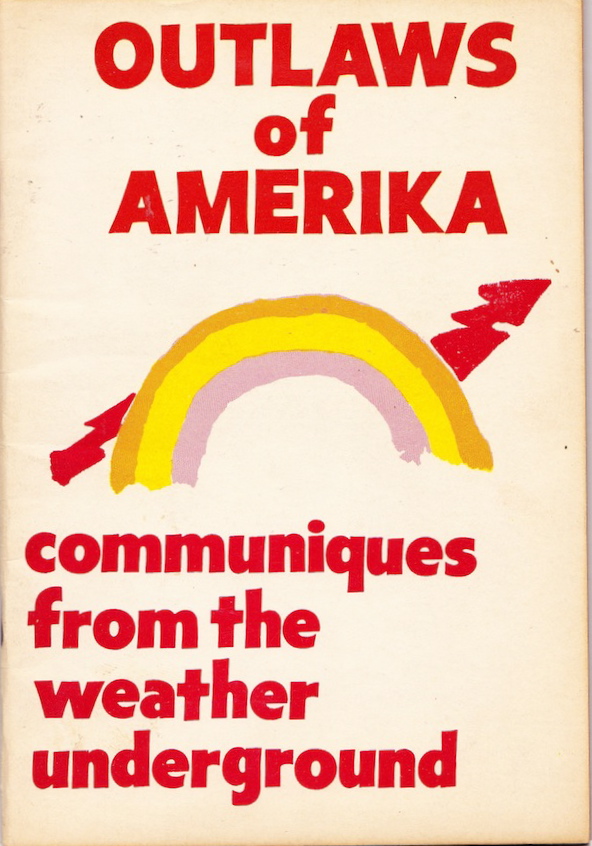
Other groups such as the Weather Underground took more drastic measures to make their case. “They engaged in property damage to bring attention to what was going on in the country,” he says. “I certainly can’t speak for them, and I hate to try to say what they did in one sentence, but basically they were unsatisfied with the pace of progress. Their goal, I think, was the same as other groups—to achieve a more-just society and end the war—but they wanted to get results more quickly.”
The Weather Underground was a more radical spinoff of the SDS.
At the other end of the spectrum were organizations like Clergy and Laymen Concerned About Vietnam, and Mothers Against the War. “Everyone helped in his or her own way,” Synchef continues. “People did what felt comfortable.”
Just as these groups in the 1960s and early ’70s drew attention to the war in Vietnam, Occupy Wall Street has had a major impact on today’s public discourse. “If one year ago you had told me that wealth inequality would be one of the focuses of the presidential campaign, I wouldn’t have believed it,” Synchef says. “Now, the disparity between the haves and the have-nots, along with the disappearing middle-class dream, is one of the main discussion points in this election.”
In 2011, the band Moonalice commissioned a number of artists, including Winston Smith, to produce posters supporting the Occupy movement.
Equally surprising, perhaps, is the notion that old pieces of paper associated with groups that often espoused anti-materialism views would become a genre of collectibles. Indeed, Synchef’s collection contains hundreds of signed items, often bearing the scrawls of numerous people involved with a particular event. But for Synchef, those signatures are less about collecting autographs in the celebrity sense than they are a desire to connect the documents in his collection with the people whose actions inspired them.
“In order to get those signatures,” he says, “I got to meet some absolutely fascinating people who were involved in a significant period in American history. The signatures link people to the movements they were involved in, like Paul Krassner to the Yippies or Ken Kesey to the Merry Pranksters. Whether it adds value to a piece of paper, I can’t say.”
(All images except the last one courtesy Richard Synchef, who can be reached at rsynchef01@yahoo.com; Occupy poster courtesy Winston Smith and Moonalice)
Thursday, July 21, 2011
FBI releases files on controversial booksellers Paladin and Loompanics
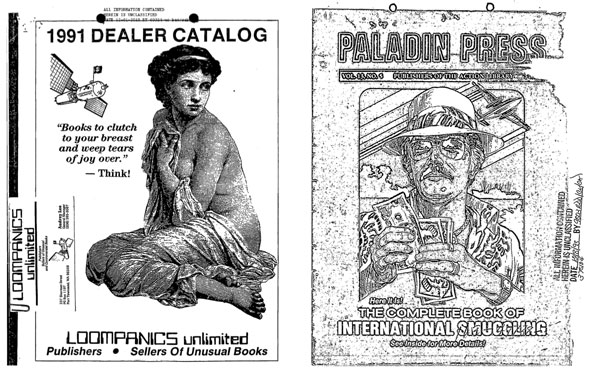
The FBI has released its files on two famously controversial publishers, Paladin Press and Loompanics Unlimited, following a FOIA request filed by Government Attic. The files suggest that the booksellers' huge libraries of books on drugs, guns and other ultra-libertarian issues only rarely drew the FBI's attention.
Though their catalogs were similar, Loompanics stood out for its countercultural style, whereas Paladin specialized in republishing declassified military guidebooks and the like. When Loompanics wound up operations in 2006, Paladin acquired part of its back catalog.
The FBI's files on Paladin Press date back some forty years, and reveal an early 1970s investigation into the classification status of the U.S. government materials that Paladin republished. Since then, however, the release shows that the bureau took little interest in it except to execute procedural inquiries on behalf of foreign investigators.
The Loompanics file is much the same. Concluding that the organization and its publications were legal, the FBI only revisited it to conduct inquiries triggered by hand-wringers and foreign cops.
Paladin Highlights
• In the early 1970s, the FBI looked into of how Paladin got hold of various government documents. A la "Wow, we declassified that? Huh."
• In 1983, a recipient of an unsolicited catalog for Paladin's books sends an angry letter to their senator, expressing disbelief "that something like this could exist in this country." The senator asks the FBI to investigate it "because of the desire of my office to be responsibe to all inquiries." The FBI: "Our review failed to find any violation of federal law ... the Paladin press has been brought to our attention in the past."
• After a Paladin video tape was found in the possession of a murder victim in Liverpool in 1997, the coppers there ask the U.S. Embassy if these guys ship guns or silencers to England or something. The FBI checks it out. Paladin says it only sells media, and refuses to provide general customer info on privacy grounds, but will do so for specifically-named suspects or victims. Once given the info, it reports that it has no records of any of them.
• Australia gets upset when Paladin republishes stuff from its classified military manuals. The resulting FBI investigation asks Paladin, where did you get that? Paladin says it bought the original manuals in a bookstore in Sidney, Australia. The FBI takes a motrin and fixes itself a drink.
Loompanics Highlights
• A typical FBI response to an inquiry from whomever: "AGAIN THIS IS NOT CLASSIFIED OR RESTRICTED MATERIAL ... THESE ITEMS ARE POSSIBLY OF INTEREST TO TERRORISTS OR EXTREMISTS, BUT, AS ALL ARE IN THE PUBLIC DOMAIN OF THE U.S., POSSESSION OF SUCH ITEMS CONSTITUTE NO VIOLATION OF LAW."
• In 1984, the FBI interviewed the "owner" of Loompanics (i.e. Mike Hoy) in order to identify a particular subscriber to Loompanics who was a suspect in a criminal investigation. He was concerned about government intervention in his business but "reluctantly" advised that in order to get on the subscriber list, you had to buy a book. The FBI concluded that he violated no laws through the operation of his mail-order bookselling business.
• In the 1980s, police in Germany make an inquiry about the origins of Loompanics materials owned by locals who, "with the help of these materials ... have been attempting to create dissention." The books were "Total Resistance


You can download the files at Government Attic's Department of Justice documents page.
Tuesday, May 10, 2011
Last Word Press Ratchets It Up A Notch
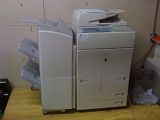
We now have the ability to make buttons, fridge magnets, and zines at lightning speed! E-mail us a .pdf and we can have a hard copy for you in seconds! Contact Rob for pricing details: lastwordpress@gmail.com
The two newest additions to our printing arsenal:
Canon 5065
Hydraulic Button Press:

And our old battle-hardened gear:


Subscribe to:
Posts (Atom)