
Showing posts with label Nuclear. Show all posts
Showing posts with label Nuclear. Show all posts
Thursday, August 23, 2012
Record Radiation Levels Measured off Japan
Record radiation found off Japan 23 Aug 2012 Record levels of radioactive caesium were detected in fish caught within 20km of Japan's damaged Fukushima Daiichi Nuclear Power Station, news reports said yesterday. The operator Tokyo Electric Power Co said Tuesday it had found 25,800 becquerels per kilogram of radioactive caesium in greenling, 258 times higher than the government safety standard. Fishing in waters off the plant has been voluntarily restricted since the nuclear disaster at the plant, which went into meltdown after the March 2011 earthquake and tsunami.


Sunday, March 11, 2012
Nuclear News from CLG
 Japanese leaders silent on meltdown 11 Mar 2012 Just four hours after a tsunami swept into the Fukushima nuclear power plant a year ago, Japan's leaders knew the damage was so severe that the reactors could melt down, but they kept their knowledge secret for months. Five days into the crisis, then-Prime Minister Naoto Kan voiced his fears that it could turn worse than Chernobyl, newly released documents show. The minutes of the government's crisis management meetings from the day the earthquake and tsunami struck until late December were not recorded and had to be reconstructed retroactively. The minutes quoted an unidentified official explaining that cooling functions of the reactors were kept running only by batteries that would last just eight hours.
Fukushima radiation measured in Ireland 08 Mar 2012 Radioactivity from the Fukushima nuclear reactor accident in Japan reached Ireland in the weeks after the event. The radioactive particles that reached Ireland were similar to those arriving as nuclear fallout here after the Chernobyl nuclear power plant disaster in 1986, according to data from the institute. The monitoring stations detected radioactive Iodine-131 and two forms of radioactive Caesium, Cs-137 and Cs-134.
Earthquake strikes Japan on eve of anniversary 10 Mar 2012 A moderate quake with a magnitude of 5.4 has struck northeastern Japan near the zone devastated last year by the massive earthquake and tsunami that triggered a nuclear crisis. There were no immediate reports of injuries or damage in the quake Saturday. The U.S. Geological Survey says the earthquake struck at 2:25 a.m. local time Saturday about 40 kilometres north of Mito, the capital of the Ibaraki Prefecture on the main island of Honshu.
Protesters link arms around the world to decry nuclear power 11 Mar 2012 Tens of thousands of anti-nuclear protesters across the globe called for an end to nuclear power as they marked the first anniversary of the earthquake and tsunami at Japan's Fukushima power plant. In Japan, tens of thousands rallied near the crippled plant, demanding an end to nuclear power. The tsunami swamped cooling systems at Fukushima and sent three reactors into meltdown, spewing radiation into the environment. Around 16,000 people gathered at a baseball stadium in Koriyama, some 60 kilometres (40 miles) from the plant. Participants called for an end to nuclear energy in Japan and compensation for victims from operator Tokyo Electric Power.
Fukushima rally to be held at San Onofre 11 Mar 2012 Dozens of Southern Californians will hold a rally to remember the meltdown of the Fukushima nuclear power plant in Japan and to raise awareness about nuclear power in California. The gathering Sunday outside the gates of the San Onofre Nuclear Generating Station in San Clemente will focus on what protesters say are dangers at the plant, which is located in southern Orange County. Southern California Edison took the San Onofre Unit 3 nuclear plant off-line last month as a precaution after detecting a leak in a tube that carries radioactive water in a steam generator. Subsequent investigation found unusual and premature wear on hundreds of similar tubes in Unit 2.
Sunday, February 05, 2012
Nuclear Power in the US: a Rigged System
The nuclear power program in the United States was set up rigged—to allow the federal government to push atomic energy with state and local governments “pre-empted” on most issues.
That’s what the State of Vermont was confronted with last week as a federal judge blocked the state’s attempts to shut down the accident-plagued Vermont Yankee nuclear plant.
But there’s a way around this federal nuclear fix—the use by states of their power of “eminent domain.” That’s a legal principle going back centuries and is how, commonly, states condemn property for a highway right-of-way if the owners refuse to sell.
The application of the state’s power of “eminent domain” to nuclear power was pioneered in New York State in the 1980s—and was how the completed Shoreham nuclear plant was stopped from opening. That ended the scheme of nuclear promoters to turn Long Island into a “nuclear park” with seven to 11 nuclear plants.
The Long Island Power Act was passed by New York State in 1985 creating a Long Island Power Authority (LIPA) with the power to seize the assets and stock of the utility behind this nuclear scheme, the Long Island Lighting Company (LILCO).
The federal government was gung-ho for Shoreham. The Nuclear Regulatory Commission (NRC) had approved the start-up of operations at Shoreham, the first of three nuclear plants to be built on that site, and the construction of two more nuclear plants at Jamesport, to be joined by two more there. More plants would go up between the two with all fronting on the Long Island Sound.
But by enacting the Long Island Power Act that utilized the state’s power of “eminent domain,” New York State made clear that if LILCO persisted with nuclear power, the state would eliminate it.
This strategy can be used by the State of Vermont—and other states—faced by the nuclear juggernaut of the federal government and nuclear industry. Indeed, it’s a strategy that needs to be pursued because it is highly unlikely that federal nuclear officials will be sensible or fair—or uphold democracy.
Monday, January 23, 2012
Fukushima Update: Why We Should (Still) Be Worried

Radioactive iodine in rainwater: Public was in the dark

Wednesday, December 21, 2011
14,000 US Deaths Tied to Fukushima Reactor Disaster Fallout: Medical Journal Article
19 Dec 2011 An estimated 14,000 excess deaths in the United States are linked to the radioactive fallout from the disaster at the Fukushima nuclear reactors in Japan, according to a major new article in the December 2011 edition of the International Journal of Health Services. This is the first peer-reviewed study published in a medical journal documenting the health hazards of Fukushima. Authors Joseph Mangano and Janette Sherman note that their estimate of 14,000 excess U.S. deaths in the 14 weeks after the Fukushima meltdowns is comparable to the 16,500 excess deaths in the 17 weeks after the Chernobyl meltdown in 1986.
Friday, August 05, 2011
Fixing American's Nuclear Waste Storage Problem
Thanks for the link, Ma!
And thanks to all our readers for the increased web-traffic! Forward our underground bookselling empire newsletters to a friend!
And thanks to all our readers for the increased web-traffic! Forward our underground bookselling empire newsletters to a friend!
Friday, July 22, 2011
Post-Fukushima: 44% Increase in Infant Mortality Rates Up West Coast of North America
http://pregnancy-blog.parentingweekly.com/2011/06/are-babies-on-west-coast-dying-from.html
This one's a bit older, I believe it's up to 44%. It got challenged for accuracy and alarmingly came back even worse.
______________________________________________
http://fromthetrenchesworldreport.com/lies-from-fukushima-are-killing-babies/5047
_____________________________________________
The province of British Columbia today announced that infant mortality for the first six months of 2011 exceeded the infant mortality for all of 2010.
Officials attribute the infant mortality spike to "poor parent training."
In the CBC story on the announcement, no mention was made of Fukushima.
- http://www.nuc.berkeley.edu/node/4550
______________________________________________
Infant Mortality Higher From Radiation US and Canada West Coast Study Finds
These folks touch on some interesting subjects not all of you may agree with...
______________________________________________
http://www.progressiveradionetwork.com/health-headlines/2011/6/13/janette-d-sherman-md-and-joseph-mangano-is-the-dramatic-incr.html
This one's a bit older, I believe it's up to 44%. It got challenged for accuracy and alarmingly came back even worse.
______________________________________________
http://fromthetrenchesworldreport.com/lies-from-fukushima-are-killing-babies/5047
_____________________________________________
The province of British Columbia today announced that infant mortality for the first six months of 2011 exceeded the infant mortality for all of 2010.
Officials attribute the infant mortality spike to "poor parent training."
In the CBC story on the announcement, no mention was made of Fukushima.
- http://www.nuc.berkeley.edu/node/4550
______________________________________________
Infant Mortality Higher From Radiation US and Canada West Coast Study Finds
These folks touch on some interesting subjects not all of you may agree with...
______________________________________________
http://www.progressiveradionetwork.com/health-headlines/2011/6/13/janette-d-sherman-md-and-joseph-mangano-is-the-dramatic-incr.html
Fort Calhoun Nuclear Plant Underwater- References of 10 Mile Mandatory Evacuation Area Scrubbed From News Sites
Care to have our own little Nuclear disaster? Or do you not want to read about that either? Might not be much of a problem, since our spin doctors and censors are hard at work.
http://blog.alexanderhiggins.com/2011/06/28/fort-calhoun-nuclear-plant-underwater-references-10-mile-radius-evacuation-order-scrubbed-internet-news-sites-32161/
http://blog.alexanderhiggins.com/2011/06/28/fort-calhoun-nuclear-plant-underwater-references-10-mile-radius-evacuation-order-scrubbed-internet-news-sites-32161/
Question: How pissed off would you be
if you found out that during the month of April alone, if you live in the Seattle or Olympia areas, you breathed in 5 Hot Particles a day of Cesium, Strontium-90 or one of a variety of scarily-named other particles? How scared would we be if our newspapers and scientists and elected officials actually told us the truth about CURRENT levels of radiation in our food and water?
Decide for yourself. I'm tired and I want to go to bed. And change all your air filters in the morning.
http://fairewinds.com/content/hot-particles-japan-seattle-virtually-undetectable-when-inhaled-or-swallowed
http://theintelhub.com/2011/06/17/nuclear-doom-hot-particles-slow-death-and-cancer/

Decide for yourself. I'm tired and I want to go to bed. And change all your air filters in the morning.
http://fairewinds.com/content/hot-particles-japan-seattle-virtually-undetectable-when-inhaled-or-swallowed
http://theintelhub.com/2011/06/17/nuclear-doom-hot-particles-slow-death-and-cancer/
Thursday, July 21, 2011
Radiation Levels in Northwest Rain Were Up to 130 Times Drinking Water Standards Following Fukushima, Japan nuclear reactor explosions
Radiation Levels in Rain in WA and OR were high enough to be of concern despite news reports and officials stating that levels were “below any level of public health concern.” Olympia rainwater had Iodine 131 at levels 41 times the federal Drinking Water Standard, Portland over 28 times the standard.
Boise, ID levels reached 130 times the Drinking Water Standard for Iodine 131 and 14 times higher for Cesium 134 – indicating higher levels fell in Oregon and Washington.
Analysis by Heart of America Northwest:
Radiation levels in rainwater collected in Portland, OR on March 25, 2011 were 86.8 pCi/L for Iodine 131 (I131), amongst the highest recorded in the US after Fukushima. Rain in Olympia and Seattle had even higher levels of radioactive Iodine. The Portland result was not posted by EPA until April 4.
The maximum level of Iodine 131in rain in Olympia, WA was 125 pCi/L on March 24, which was not posted by EPA until April 4. In Seattle, an Iodine 131 level of 161 pCi/L was in rain collected on March 25.
Highest levels in rainwater in California were collected March 22, 2011 in Richmond, CA with levels of 138 pCi/L.
The Drinking Water Standard is just 3 pCi/L (picoCuries per Liter, which is a very small measurement). Thus, people drinking undiluted rainwater in Portland would have consumed and been exposed to Iodine 131 at levels nearly 30 times the DWS, and 41 times the standard in Olympia. There are no results for Seattle or Bellingham areas posted by EPA, although an even higher reading of 161 pCi/L of Iodine 131 in “Seatle area” rain on March 25 was posted by Washington Dept. of Health on its website. The Seattle result was more than 53 times the Drinking Water Standard (DWS).
The Drinking Water Standard (DWS) is set at a level based on drinking 2L/day resulting in a 4 mrem per year dose, which is a 1 in 10,000 lifetime risk of fatal cancer in adults, if consumed daily over 30 years. Children are 3 to 10 times more susceptible to develop cancer from the same dose, especially because Iodine concentrates in young thyroids. Of course, Iodine 131 may cause non-cancerous health conditions. Total cancer risk is cumulative. Thus, exposure to multiple contaminants, such as Iodine 131 as well as Cesium, increases risk.
If the rain in Richmond, CA had high levels on March 22, one might expect that EPA would have been testing the same day or as close as possible at Pacific Northwest locations that day. However, locations only test once a week or once a month without apparent coordination related to the event, e.g., without apparent increased testing based on weather patterns from Japan and daily events, such as explosions at Fukushima.
The highest levels of Iodine 131 in rain were collected in Boise, Idaho on March 27 and March 22, 2011 with levels of 390 and 242 pCi/L, respectively. Two different types of radioactive Cesium, which remain dangerous for many years, were also found in the Boise rain water on March 22 and March 27. The March 27 results were 14 and 12 times the Drinking Water Standards for Cesium 134 and 137 respectively.
Rain falling in Boise with elevated levels of radioactive Cesium and Iodine should have triggered increased monitoring in Oregon, and Western Washington, where the clouds likely dropped rain and contamination before reaching Boise. However, EPA reports only two monitoring results a month apart for all of Oregon during the Fukushima reactor crisis.
A high level reported by EPA was 150 pCi/L collected in Jacksonville, FL on March 31. This shows how far and wide the contamination can, and did, spread. It also reveals that claims and news reports were false in presenting that the 8 day half-life of Iodine 131 (half of the radiation remains) meant that contamination would not reach across the US. If levels of 150 were in rain in Jacksonville, the levels were much higher days earlier on the West Coast.
If Iodine 131 levels of 390 pCi/L reached Boise, 130 times the Drinking Water Standard, the same clouds likely dropped precipitation at levels of Iodine and Cesium 50% higher in Oregon and Washington before reaching Boise.
There were no samples collected and reported in Oregon and WA in the days immediately prior to the Boise collection of a sample with 242 pCi/L on March 22nd. Portland had only two precipitation samples reported during this entire period, the second on April 20, with all results “non-detects”. These results were not posted by EPA until May 24.
While there are numerous results collected at Oak Ridge, home of USDOE’s Oak Ridge National Lab, it appears that USDOE’s Hanford site and Pacific NW National Lab were not part of EPA’s collection program – despite claims of extensive radiological monitoring at Hanford.
EPA refuses to make public who is collecting data samples for its RadNet program, preventing independent review of accuracy and raising concern that the choices as to sampling may be biased, and leaving numerous questions such as why some collection stations were only collecting monthly even at the height of the crisis (e.g., Portland). Heart of America Northwest, working with activist/singer Dana Lyons, is submitting a Freedom of Information act request to EPA to find out the reliability and location of whoever EPA is getting its samples from.
EPA’s announcement that it was returning to “routine” sampling implied that there was across the board increased sampling from mid-March to May3, 2011. However, a review of the posted sampling results show many locations, such as Portland, OR, did not increase precipitation sampling from once a month during the crisis.
EPA’s May 3 Statement:
“After a thorough data review showing declining radiation levels related to the Japanese nuclear incident, EPA has returned to the routine RadNet sampling and analysis process for precipitation, drinking water and milk.
“As always, EPA's RadNet system of more than 100 stationary monitors will continue to provide EPA scientists near-real-time data on the slightest fluctuations in background radiation levels….
“It is important to note that all of the radiation levels detected by RadNet monitors and sampling have been very low, are well below any level of public health concern, and continue to decrease over time. EPA continues to work with federal partners to monitor the situation in Japan and stands prepared to accelerate radiation sampling and analysis if the need arises. Data will continue to be available on EPA's public website.”
Heart of America Northwest’s review shows that EPA’s claim of “near real-time data” is belied by EPA taking a week to post data. In the event of another explosion releasing radioactive particles and gases, the serious week long gap in time between collection of results and posting could prevent a proper public health advisory and response. By taking a week to post results, the public is deprived of the ability to make its own choices in time to make a difference.
EPA should continue weekly testing of food, and include cheese and other dairy products and spinach, given the presence of elevated levels of Cesium 134 and 137, with half lives of 30 years, in Boise samples.
All data from EPA: http://www.epa.gov/japan2011/rert/radnet-sampling-data.html
Boise, ID levels reached 130 times the Drinking Water Standard for Iodine 131 and 14 times higher for Cesium 134 – indicating higher levels fell in Oregon and Washington.
Analysis by Heart of America Northwest:
Radiation levels in rainwater collected in Portland, OR on March 25, 2011 were 86.8 pCi/L for Iodine 131 (I131), amongst the highest recorded in the US after Fukushima. Rain in Olympia and Seattle had even higher levels of radioactive Iodine. The Portland result was not posted by EPA until April 4.
The maximum level of Iodine 131in rain in Olympia, WA was 125 pCi/L on March 24, which was not posted by EPA until April 4. In Seattle, an Iodine 131 level of 161 pCi/L was in rain collected on March 25.
Highest levels in rainwater in California were collected March 22, 2011 in Richmond, CA with levels of 138 pCi/L.
The Drinking Water Standard is just 3 pCi/L (picoCuries per Liter, which is a very small measurement). Thus, people drinking undiluted rainwater in Portland would have consumed and been exposed to Iodine 131 at levels nearly 30 times the DWS, and 41 times the standard in Olympia. There are no results for Seattle or Bellingham areas posted by EPA, although an even higher reading of 161 pCi/L of Iodine 131 in “Seatle area” rain on March 25 was posted by Washington Dept. of Health on its website. The Seattle result was more than 53 times the Drinking Water Standard (DWS).
The Drinking Water Standard (DWS) is set at a level based on drinking 2L/day resulting in a 4 mrem per year dose, which is a 1 in 10,000 lifetime risk of fatal cancer in adults, if consumed daily over 30 years. Children are 3 to 10 times more susceptible to develop cancer from the same dose, especially because Iodine concentrates in young thyroids. Of course, Iodine 131 may cause non-cancerous health conditions. Total cancer risk is cumulative. Thus, exposure to multiple contaminants, such as Iodine 131 as well as Cesium, increases risk.
If the rain in Richmond, CA had high levels on March 22, one might expect that EPA would have been testing the same day or as close as possible at Pacific Northwest locations that day. However, locations only test once a week or once a month without apparent coordination related to the event, e.g., without apparent increased testing based on weather patterns from Japan and daily events, such as explosions at Fukushima.
The highest levels of Iodine 131 in rain were collected in Boise, Idaho on March 27 and March 22, 2011 with levels of 390 and 242 pCi/L, respectively. Two different types of radioactive Cesium, which remain dangerous for many years, were also found in the Boise rain water on March 22 and March 27. The March 27 results were 14 and 12 times the Drinking Water Standards for Cesium 134 and 137 respectively.
Rain falling in Boise with elevated levels of radioactive Cesium and Iodine should have triggered increased monitoring in Oregon, and Western Washington, where the clouds likely dropped rain and contamination before reaching Boise. However, EPA reports only two monitoring results a month apart for all of Oregon during the Fukushima reactor crisis.
A high level reported by EPA was 150 pCi/L collected in Jacksonville, FL on March 31. This shows how far and wide the contamination can, and did, spread. It also reveals that claims and news reports were false in presenting that the 8 day half-life of Iodine 131 (half of the radiation remains) meant that contamination would not reach across the US. If levels of 150 were in rain in Jacksonville, the levels were much higher days earlier on the West Coast.
If Iodine 131 levels of 390 pCi/L reached Boise, 130 times the Drinking Water Standard, the same clouds likely dropped precipitation at levels of Iodine and Cesium 50% higher in Oregon and Washington before reaching Boise.
There were no samples collected and reported in Oregon and WA in the days immediately prior to the Boise collection of a sample with 242 pCi/L on March 22nd. Portland had only two precipitation samples reported during this entire period, the second on April 20, with all results “non-detects”. These results were not posted by EPA until May 24.
While there are numerous results collected at Oak Ridge, home of USDOE’s Oak Ridge National Lab, it appears that USDOE’s Hanford site and Pacific NW National Lab were not part of EPA’s collection program – despite claims of extensive radiological monitoring at Hanford.
EPA refuses to make public who is collecting data samples for its RadNet program, preventing independent review of accuracy and raising concern that the choices as to sampling may be biased, and leaving numerous questions such as why some collection stations were only collecting monthly even at the height of the crisis (e.g., Portland). Heart of America Northwest, working with activist/singer Dana Lyons, is submitting a Freedom of Information act request to EPA to find out the reliability and location of whoever EPA is getting its samples from.
EPA’s announcement that it was returning to “routine” sampling implied that there was across the board increased sampling from mid-March to May3, 2011. However, a review of the posted sampling results show many locations, such as Portland, OR, did not increase precipitation sampling from once a month during the crisis.
EPA’s May 3 Statement:
“After a thorough data review showing declining radiation levels related to the Japanese nuclear incident, EPA has returned to the routine RadNet sampling and analysis process for precipitation, drinking water and milk.
“As always, EPA's RadNet system of more than 100 stationary monitors will continue to provide EPA scientists near-real-time data on the slightest fluctuations in background radiation levels….
“It is important to note that all of the radiation levels detected by RadNet monitors and sampling have been very low, are well below any level of public health concern, and continue to decrease over time. EPA continues to work with federal partners to monitor the situation in Japan and stands prepared to accelerate radiation sampling and analysis if the need arises. Data will continue to be available on EPA's public website.”
Heart of America Northwest’s review shows that EPA’s claim of “near real-time data” is belied by EPA taking a week to post data. In the event of another explosion releasing radioactive particles and gases, the serious week long gap in time between collection of results and posting could prevent a proper public health advisory and response. By taking a week to post results, the public is deprived of the ability to make its own choices in time to make a difference.
EPA should continue weekly testing of food, and include cheese and other dairy products and spinach, given the presence of elevated levels of Cesium 134 and 137, with half lives of 30 years, in Boise samples.
All data from EPA: http://www.epa.gov/japan2011/rert/radnet-sampling-data.html
Friday, July 15, 2011
High levels of radiation detected in Northwest rainwater

Point here being: what else aren't they telling us that we might care to know?
SEATTLE -- A Seattle nuclear watchdog group is accusing the federal government of failing to keep the public informed of radiation from the Fukushima nuclear disaster.
In the days following the earthquake and tsunami in Japan, the U.S. began monitoring radiation from Japan's leaking nuclear power plants.
Most of the public attention went to the air monitoring which showed little or no radiation coming our way. But things were different on the rain water side.
"The level that was detected on March 24 was 41 times the drinking water standard," said Gerry Pollet from Heart of America Northwest. He reviewed Iodine 131 numbers released by the Environmental Protection Agency last spring.
"Our government said no health levels, no health levels were exceeded.When in fact the rain water in the Northwest is reaching levels 130 times the drinking water standards," said Pollet.
Elevated rain water samples were collected in Portland, Olympia and Boise, which had the highest.
But EPA officials say the data was there for anyone to read on their website. A spokesman sent this statement, in part:
"Since Iodine 131 has a very short half-life of approximately eight days, the levels seen in rainwater were expected to be relatively short in duration."
State health agencies added that they constantly monitored public drinking water sources and never found levels even approaching the unhealthy range.
Even the watchdog group admits, watering plants with water exposed only briefly to those levels is unlikely to cause health problems.
But they say it's information the public deserves to know about.
The EPA points out this was a brief period of elevated radiation in rainwater, and says safe drinking water standards are based on chronic exposure to radiation over a lifetime.
Tuesday, July 05, 2011
Fukushima Spews, Los Alamos Burns, Vermont Rages and We've Almost Lost Nebraska
Fukushima Spews, Los Alamos Burns, Vermont Rages and We’ve Almost Lost Nebraska
Humankind is now threatened by the simultaneous implosion, explosion, incineration, courtroom contempt and drowning of its most lethal industry.
We know only two things for certain: worse is yet to come, and those in charge are lying about it---at least to the extent of what they actually know, which is nowhere near enough.
Humankind is now threatened by the simultaneous implosion, explosion, incineration, courtroom contempt and drowning of its most lethal industry.
We know only two things for certain: worse is yet to come, and those in charge are lying about it---at least to the extent of what they actually know, which is nowhere near enough.
Indeed, the assurances from the nuke power industry continue to flow like the floodwaters now swamping the Missouri Valley heartland.
But major breakthroughs have come from a Pennsylvania Senator and New York’s Governor on issues of evacuation and shut-down. And a public campaign for an end to loan guarantees could put an end to the US industry once and for all.
FUKUSHIMA: The bad news continues to bleed from Japan with no end in sight. The “light at the end of the tunnel” is an out-of-control radioactive freight train, heading right into a beleaguered planet.
Widespread internal radioactive contamination among Japanese citizens around Fukushima has now been confirmed. http://nukefree.org/...
Two whales caught some 650 kilometers from the melting reactors have shown intense radiation. http://blog.alexanderhiggins.com/...
Plutonium, the deadliest substance known to our species, has been found dangerously far from the site.
Wednesday, June 29, 2011
Nebraska Nuke Watch: Keeping an eye on Cooper & Ft.Calhoun nuclear plants
Awesome! Thanks for the link mom.
Interesting tidbit from this blog: American Cable TV Boxes waste 3 Billion Dollars a year in electricity when no one is watching television and they aren't even recording anything.
Interesting tidbit from this blog: American Cable TV Boxes waste 3 Billion Dollars a year in electricity when no one is watching television and they aren't even recording anything.
Wednesday, June 22, 2011
Dangerous radiation leaked from three-quarters of U.S. nuclear power plants

--Water tested around 37 facilities contained radioactive concentrations exceeding U.S. drinking water standard and in some cases at hundreds of times over limit 21 Jun 2011 Dangerous radiation has leaked from three-quarters of all U.S. nuclear power stations raising fears the country's water supplies could one day be contaminated. The number and severity of leaks has increased because of the many old and unsafe plants across America, a new investigation has claimed. Radioactive tritium has escaped at least 48 of 65 of all U.S. sites, often entering water around the plants through rusty old pipes.
Tuesday, June 21, 2011
Rising Water, Falling Journalism - Nuclear Danger in Nebraska
I just lifted the
 Every evening, my father climbs the levee along the Missouri River in Council Bluffs, Iowa, and peers down into the black water that swallows the road. The water is rising, and the Army Corps of Engineers says the levee has never faced such a test. Dad, a retired professor, is packing his books and papers. If the levee doesn't hold, his one-story house could be underwater for months.
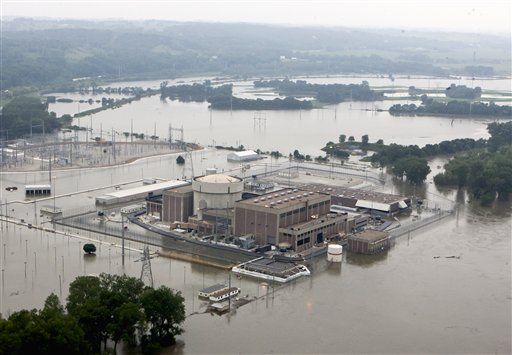
A little farther up the Missouri, at the Fort Calhoun Nuclear Power Station near Blair, Nebraska, the river is already lapping at the Aqua Dams -- giant plastic tubes filled with water -- that form a stockade around the plant's buildings. The plant has become an island.
© AP
The Fort Calhoun nuclear power station in Fort Calhoun, Neb., currently shut down for refueling, is surrounded by flood waters from the Missouri River, Tuesday, June 14, 2011. On Tuesday, the releases at Gavins Point Dam in South Dakota hit the maximum planned amount of 150,000 cubic feet of water per second, which are expected to raise the Missouri River 5 to 7 feet above flood stage in most of Nebraska and Iowa.
The Fort Calhoun nuclear power station in Fort Calhoun, Neb., currently shut down for refueling, is surrounded by flood waters from the Missouri River, Tuesday, June 14, 2011. On Tuesday, the releases at Gavins Point Dam in South Dakota hit the maximum planned amount of 150,000 cubic feet of water per second, which are expected to raise the Missouri River 5 to 7 feet above flood stage in most of Nebraska and Iowa.
The Nuclear Regulatory Commission (NRC) issued a "yellow finding" (indicating a safety significance somewhere between moderate and high) for the plant last October, after determining that the Omaha Public Power District (OPPD) "did not adequately prescribe steps to mitigate external flood conditions in the auxiliary building and intake structure" in the event of a worst-case Missouri River flood. The auxiliary building -- which surrounds the reactor building like a horseshoe flung around a stake -- is where the plant's spent-fuel pool and emergency generators are located.
OPPD has since taken corrective measures, including sealing potential floodwater-penetration points, installing emergency flood panels, and revising sandbagging procedures. It's extremely unlikely that this year's flood, no matter how historic, will turn into a worst-case scenario: That would happen only if an upstream dam were to instantaneously disintegrate. Nevertheless, in March of this year the NRC identified Fort Calhoun as one of three nuclear plants requiring the agency's highest level of oversight. In the meantime, the water continues to rise.
No guarantees. On June 7, there was a fire -- apparently unrelated to the flooding -- in an electrical switchgear room at Fort Calhoun. For about 90 minutes, the pool where spent fuel is stored had no power for cooling. OPPD reported that "offsite power remained available, as well as the emergency diesel generators if needed." But the incident was yet another reminder of the plant's potential vulnerability.
And so, Fort Calhoun remains on emergency alert because of the flood -- which is expected to worsen by early next week. On June 9, the Army Corps of Engineers announced that the Missouri River would crest at least two feet higher in Blair than previously anticipated.
The Fort Calhoun plant has never experienced a flood like this before. The plant began commercial operation in 1973, long after the construction of six huge dams -- from Fort Peck in Montana to Gavins Point in South Dakota -- that control the Missouri River flows and normally prevent major floods. But, this spring, heavy rains and high snowpack levels in Montana, northern Wyoming, and the western Dakotas have filled reservoirs to capacity, and unprecedented releases from the dams are now reaching Omaha and other cities in the Missouri River valley. Floodgates that haven't been opened in 50 years are spilling 150,000 cubic feet per second -- enough water to fill more than a hundred Olympic-size swimming pools in one minute. And Fort Calhoun isn't the only power plant affected by flooding on the Missouri: The much larger Cooper Nuclear Station in Brownville, Nebraska, sits below the Missouri's confluence with the Platte River -- which is also flooding. Workers at Cooper have constructed barriers and stockpiled fuel for the plant's three diesel generators while, like their colleagues at Fort Calhoun, they wait for the inevitable.
To be sure, there are coal-fired power plants on the river in Sioux City and Council Bluffs, Iowa -- north and south of Fort Calhoun, respectively -- that presumably could provide backup power if the nuclear plant were to lose power. Operators at the coal plants are protecting critical structures with berms and sandbags, but they can't guarantee that a levee break won't take the plants offline.
Failure of the fourth estate. Newspapers and websites all over the country have reported on the flooding and fire at Fort Calhoun, but most articles simply paraphrase and regurgitate information from the NRC and OPPD press releases, which aggregators and bloggers then, in turn, simply cut and paste. Even the Omaha World-Herald didn't send local reporters to cover the story; instead, the newspaper published an article on the recent fire written by Associated Press reporters -- based in Atlanta and Washington.
Unsurprisingly, much of the information in recent press reports has lacked context. For example:
Virtually every article about the flooding mentions that the Fort Calhoun plant was shut down on April 9. On May 27, the Omaha World-Herald reported, "The Omaha Public Power District said its nuclear plant at Fort Calhoun, which is shut down for maintenance, is safe from flooding." The implication is that being shut down makes a plant safe. But as the ongoing crisis in Fukushima demonstrates, nuclear fuel remains hot long after a reactor is shut down. When Fort Calhoun is shut down for maintenance and refueling, only one-third of the fuel in the reactor core is removed. Besides the hot fuel remaining in the core, there is even more fuel stored in the spent-fuel pool, which is not shut down. According to a May 2011 report by Robert Alvarez at the Institute for Policy Studies, there are an estimated 1,054 assemblies of spent fuel, weighing 379 tons, at Fort Calhoun. The oldest of these assemblies are in dry-cask storage, which does not require any water or electricity for cooling. Like the dry casks at Fukushima, which survived the tsunami unscathed, the Fort Calhoun casks do not appear to be in any danger from flooding.
Many news outlets copied this sentence from a June 6 OPPD press release announcing a low-level emergency: "According to projections from the US Army Corps of Engineers, the river level at the plant site is expected to reach 1,004 feet above mean sea level later this week, and is expected to remain above that level for more than one month." Though hardly reassuring news so far, missing from these reports (and from the original release) was the elevation of the plant itself, which turns out to be -- surprise! -- 1,004 feet. According to NRC Senior Public Affairs Officer Victor Dricks, the river yesterday was at 1,005.7 feet and is expected to crest at 1,006.4 feet. By then, the plant will be standing in more than two feet of water; luckily, the eight-foot-tall Aqua Dams should keep the water at bay. And the river is still well below the worst-imaginable scenario that OPPD is required to prepare for: a flood reaching 1,014 feet above sea level. Nevertheless, in the absence of any context, the press-release language is meaningless to any reader in the neighboring communities.
Almost every article about the fire and power loss at Fort Calhoun has quoted an OPPD spokesman who said that a diesel-powered backup pump was "available" but not needed. None of these articles, however, told readers how much diesel fuel is stored at the plant, how many generators and batteries are on site, and how long they could keep coolant circulating through both the reactor and spent-fuel pool. For the record, there are two emergency diesel generators at Fort Calhoun. According to Dricks, there is usually enough fuel on site to provide cooling for two weeks, but currently the plant has sufficient fuel for four weeks. Of course, the average newspaper reader would never know any of that or be privy to the timeline of potential events.
Finally, many articles have reported that the temperature in the spent-fuel pools rose 2 degrees during the recent power outage. That may not sound like much, but only a few articles told readers the actual temperature of the pool. And a 2 degree rise from, say, 210 degrees Fahrenheit to 212 degrees Fahrenheit (the boiling point for water) would be catastrophic. The pool is normally kept at about 80 degrees Fahrenheit. OPPD estimated that, in the absence of any power to circulate coolant, it would take about 88 hours before water in the pool would begin boiling.
Admittedly, it's not easy finding information about Fort Calhoun, even if you're a local reporter without a tight deadline. OPPD press releases and the company's online newsroom do not provide details about the plant's layout and components. Some of that information was available before 9/11 but was removed because of concerns about terrorism. In protecting ourselves from enemies, we have also hidden vital information from ourselves. So finding the relevant facts takes some digging and dialing, and most newsrooms today don't have that kind of manpower. That's especially true at newspapers scrambling to cover a multitude of flood impacts across the region.
A June 9 report delivered by the Federal Communications Commission (FCC), "Information Needs of Communities," states that the number of full-time journalists at daily newspapers has fallen from a peak of about 56,900 in 1989 to 41,600 in 2010 -- fewer than before Watergate. As the FCC report observes:
An abundance of media outlets does not translate into an abundance of reporting. In many communities, there are now more outlets, but less local accountability reporting.
While digital technology has empowered people in many ways, the concurrent decline in local reporting has, in other cases, shifted power away from citizens to government and other powerful institutions, which can more often set the news agenda.
In the absence of in-depth professional reporting on the situation at Fort Calhoun, OPPD created a web page to respond to the flurry of rumors flying around the Internet. One rumor concerns the no-fly zone ordered by the FAA on June 6, which extends two miles around, and 3,500 feet above, the nuclear plant. Contrary to rumor, the no-fly zone has nothing to do with a radioactivity release. But OPPD's rumor-control page neglects to mention that the utility requested the zone, ostensibly because of work being done on overhead power lines but also because of undisclosed "security reasons." An OPPD spokesperson said that the utility is worried about news helicopters flying low over the plant.
Greater government and industry transparency can give citizens and reporters a better understanding of what's happening at the nation's nuclear power plants, and help prevent rumors from dominating the airwaves. Nonprofit organizations such as the Bulletin can help fill today's information gap. But local reporting ultimately relies on readers and advertisers who are willing to support it. Meanwhile, in the absence of reliable information, my dad continues his evening walks to the levee and peers into the rising water to judge for himself.
Monday, June 20, 2011
Israel reveals it has returned dozens of kilograms of nuclear waste to U.S.
--Israel's Nuclear Energy Commission head tells IAEA commission that Sorek reactor's nuclear waste was returned to U.S. as part of agreement 20 Jun 2011 Israel has returned nuclear waste from its Sorek nuclear reactor to the U.S., the head of Israel's Nuclear Energy Commission Dr Shaul Horev revealed on Monday. Speaking at the International Atomic Energy Agency (IAEA) ministerial conference on nuclear safety in Vienna, Horev did not specify the exact amount of waste that had been returned, but according to estimates, Israel has sent back at least dozens of kilograms, probably more, of 93% enriched uranium, which was used to power the Sorek reactor.
Subscribe to:
Posts (Atom)